
Choosing an ADAS calibration frame can become confusing quickly.
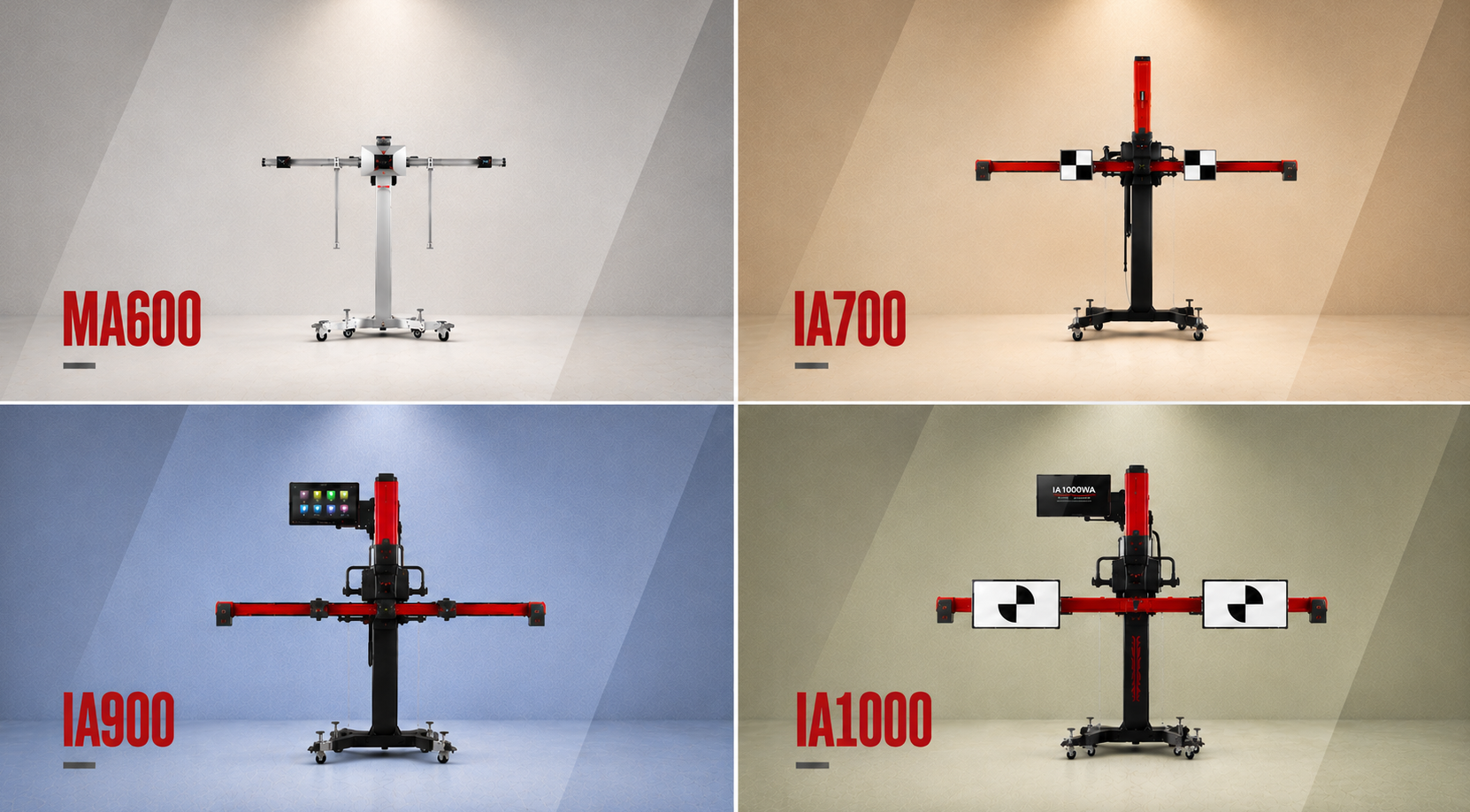
Autel offers four primary frame families, the MA600, IA700, IA900 and IA1000, and each can support accurate calibrations when used with the correct targets, software, setup and OEM procedure.
Forget searching for the "perfect" universal system; the real goal is finding the frame that aligns perfectly with your shop’s unique daily workflow.
A mobile glass company may value portability more than automation. A collision center with a dedicated calibration bay may care more about daily throughput and alignment capability. A high-volume shop or calibration center may place greater value on automation, repeatability and reducing the amount of manual setup required from the technician.
These four systems are not simply a good-better-best progression. They represent different balances of mobility, setup effort, technician involvement, alignment capability, automation and investment.
Understanding those differences can help you choose a system that fits your operation today without ignoring where your business may be headed next.
At AATI, we’ve worked extensively with all four frames discussed in this article, using them for actual repairs in our Studio Calibration Center as well as in our hands-on training classes. We wanted to share what we’ve learned from that experience with you.
By reading this blog, you’ll get a clear overview of each frame’s core feature set, top-line benefits and key differentiators.
Need help finding the right ADAS frame? Use our free ADAS Equipment Advisor.
At a Glance: Matching Autel Frames to Your Business
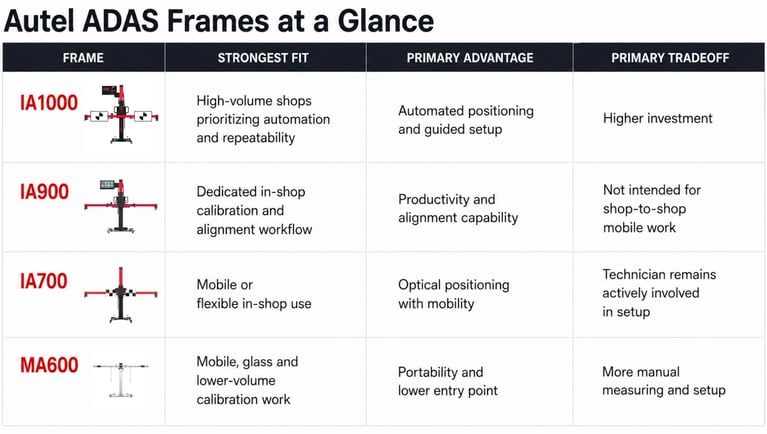
The MA600 is best suited to mobile and lower-volume operations that need portability and are comfortable with a more manual setup process.
The IA700 fits shops that still want mobile or bay-to-bay flexibility but want optical positioning, alignment pre-check and unlevel-floor compensation to reduce some of the manual setup burden.
The IA900 moves into a more production-focused in-shop workflow, combining optical positioning and robotic frame movement with the ability to perform four-wheel alignment when appropriately configured.
The IA1000 takes automation further with robotic forward-facing target positioning, laser-guided placement assistance, automated floor compensation, integrated wheel alignment and support for digital targets.
Start With Your Shop, Not the Specification Sheet
Before comparing features, start with the work the system needs to support.
Where will calibrations be performed? Will the frame remain in a dedicated bay, move between bays or travel to customer locations? How many vehicles and individual calibrations do you expect each week? Who will operate the system, and how comfortable is that technician with measurements, target placement and OEM procedures?
The physical environment matters too.
As I-CAR explains in its guidance on considerations for static calibration, OEM procedures can specify requirements for floor conditions, open space around the vehicle, lighting, vehicle preparation and target placement. Floor compensation can help address certain setup challenges, but it does not replace the need to follow the OEM procedure for the specific vehicle.
If you are still determining whether your facility is suitable, our guide to ADAS calibration bay equipment, space and setup requirements takes a closer look at the environmental factors that need to be considered before bringing calibration in-house.
Alignment is another important dividing line. Some shops primarily need to confirm that alignment is within specification before calibration. Others want to perform the actual four-wheel alignment as part of the same workflow.
Finally, consider growth. A lower-cost system can be the right choice if your calibration volume will remain modest. But if demand increases quickly, additional manual setup time can eventually become a production constraint.

Detailed Comparison of Autel Calibration Systems
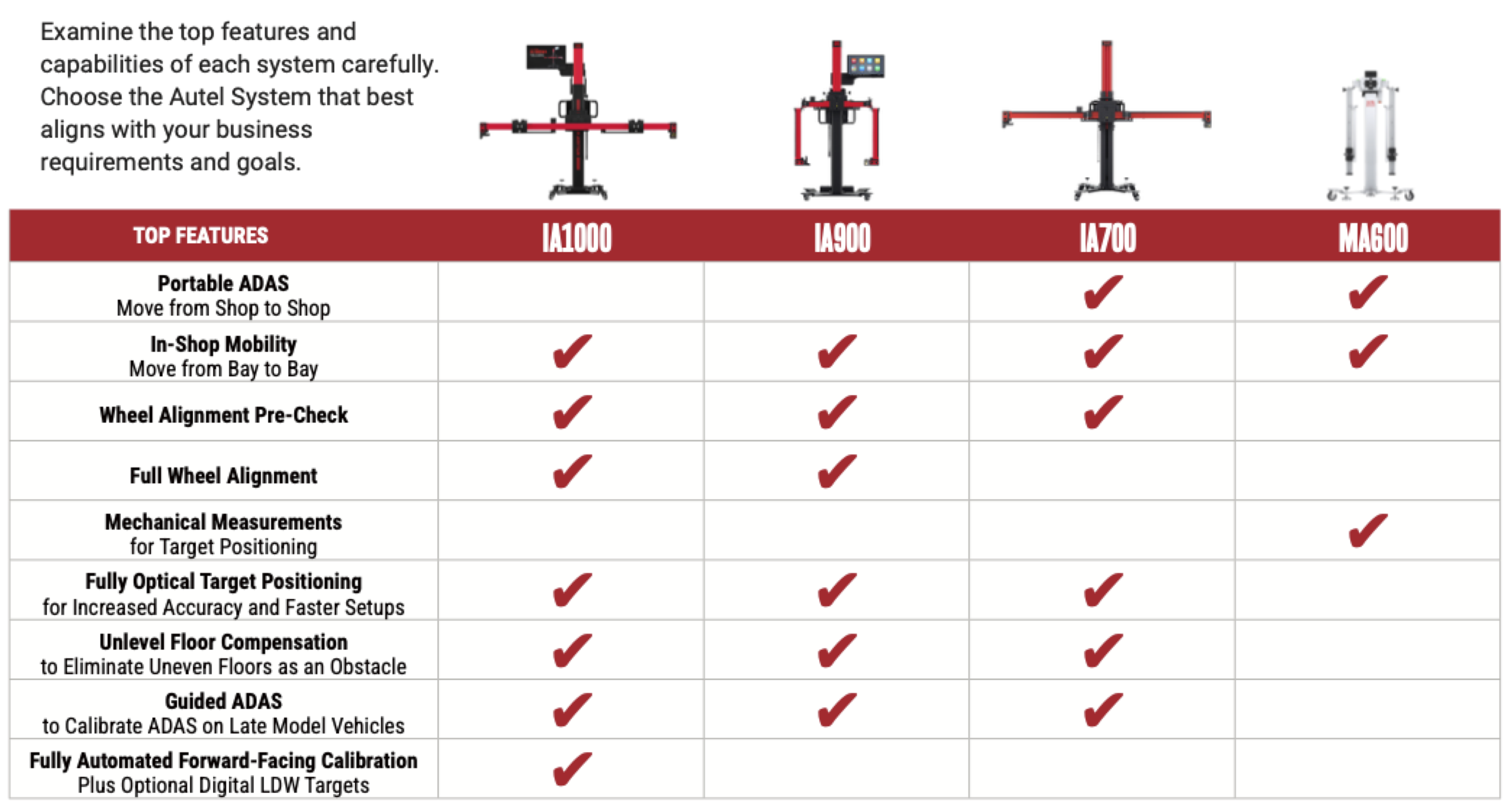
The following chart highlights the top features and core capabilities of each Autel system to help you evaluate which platform best aligns with your shop’s unique workflow and business goals.
MA600: A Portable Entry Point With More Manual Setup
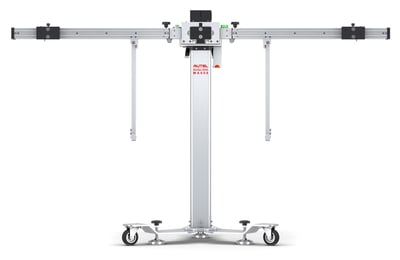
The Autel MaxiSYS MA600 is the most portable of the four frame families. Its collapsible aluminum frame is designed to fold for transport and storage, making it a practical option for mobile calibrators, glass companies and shops that cannot dedicate permanent floor space to a calibration frame.
Its greatest advantage is flexibility.
The frame can travel to another shop, be stored when it is not needed or be deployed in different work areas. That can be especially valuable for a company whose primary work involves windshield replacement and forward-facing camera calibration, or for a business that wants to build calibration volume gradually before committing to a more permanent production environment.
The tradeoff is greater technician involvement.
The operator remains responsible for more of the measuring, positioning and physical adjustment required to establish the calibration setup. That means accuracy depends heavily on good technique, patience and attention to detail.
There is also a throughput consideration.
In our own real-world experience, an experienced technician using the MA600 may complete roughly three or four vehicles during a productive day, depending heavily on the vehicle mix and procedures involved. That should not be viewed as a production guarantee. It simply illustrates an important business point: purchase price is only one part of equipment cost. Technician time matters too.
For a shop performing a modest number of calibrations, that tradeoff may make perfect sense.
For a busy calibration center, the time spent repeatedly measuring and positioning may eventually become a bottleneck.
The MA600 is also not designed to provide a complete wheel-alignment workflow. If alignment is something you ultimately want to bring into the same process, one of the more advanced frame families will likely make more sense.
Best fit: A mobile calibrator, glass company or lower-volume shop that values portability and accepts more hands-on setup in exchange for a flexible entry point.
IA700: Mobile Flexibility With Optical Positioning
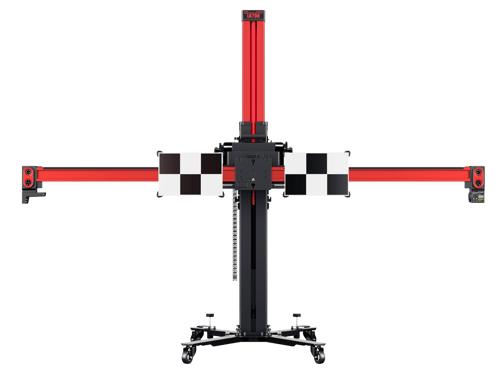
The Autel IA700 occupies an important middle ground.
It is designed for both in-shop and mobile applications and can move from bay to bay or shop to shop. Unlike the MA600, however, the IA700 uses optical positioning and wheel targets to assist with frame placement. It also provides an alignment pre-check and unlevel-floor compensation.
That combination makes the IA700 particularly interesting for shops that want to retain mobility while reducing some of the manual work associated with calibration setup.
The system uses six high-resolution positioning and tracking cameras, and Autel states that its optical positioning can significantly reduce target setup time compared with mechanical measurement. The frame can also be disassembled for transport or space-saving storage.
In practical terms, the technician still performs the calibration, follows the OEM procedure and remains responsible for the accuracy of the setup. But the IA700 gives that technician more information and positioning assistance than the MA600.
That can be particularly valuable for a mobile provider entering unfamiliar facilities where floor conditions and available workspace change from one location to another.
The IA700 should not, however, be mistaken for a fully automated calibration system.
Certain procedures can still involve manual target or pattern placement, measurements and careful positioning. Optical assistance makes the process easier and faster, but it does not eliminate the need for a trained operator.
Alignment capability is another important distinction.
The IA700 provides a wheel-alignment pre-check, allowing the shop to determine whether the vehicle is within manufacturer alignment tolerances before calibration. It does not provide the same complete four-wheel alignment workflow offered by the IA900 and IA1000.
That distinction matters because vehicle geometry is fundamental to successful calibration. We discuss that relationship in more detail in Why Wheel Alignment Is the Unskippable First Step of ADAS Calibration.
Best fit: A mobile calibration provider or shop that wants more setup assistance than the MA600 while retaining the ability to move the frame between bays or locations.
IA900: In-Shop Productivity and Integrated Alignment
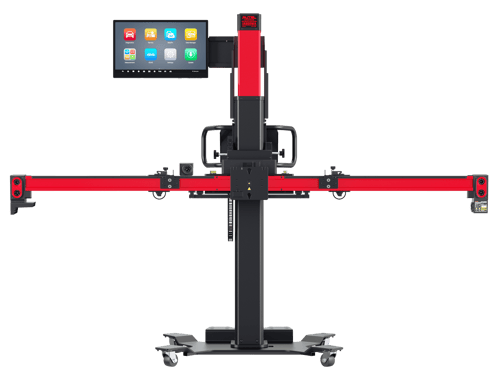
The Autel IA900 represents a significant move toward a dedicated in-shop production workflow.
The IA900WA combines ADAS calibration with four-wheel alignment capability. Six high-resolution positioning and tracking cameras monitor the vehicle and wheel targets, while robotic frame movement and guided software help establish the proper calibration position. Autel also specifies alignment-reading accuracy to 0.02 degrees.
For an established calibration operation, those capabilities can translate directly into workflow efficiency.
Forward-facing camera, radar and other frequently performed calibrations can be set up with less repeated measuring and physical adjustment than with a more manual system.
In our own calibration work, an experienced technician using the IA900 may complete approximately eight to ten vehicles, or roughly 12 to 16 individual calibrations, during a productive day depending on the vehicle and procedure mix.
Again, those figures are not manufacturer specifications or guaranteed production numbers. They are an example of why throughput should be part of the equipment decision.
The IA900 does not eliminate manual work altogether.
Around-view monitoring and certain other procedures may still require floor patterns, centerlines or careful target placement. What changes is the amount of repetitive setup involved in many of the procedures a calibration business performs most often.
The integrated alignment capability can also strengthen the business case.
Instead of treating wheel alignment and ADAS calibration as unrelated operations, a properly equipped shop can verify alignment, make necessary adjustments and move into calibration as part of a more connected workflow.
That can help reduce vehicle movement, sublet delays and handoffs between departments.
The IA900 is designed as an in-shop system. Although it can be moved within a facility, it is not intended to be broken down and transported from shop to shop like the MA600 or IA700. A shop purchasing it should have a suitable environment where the equipment can be protected and used consistently.
Best fit: A busy in-shop calibration operation with trained technicians, sufficient calibration volume and an interest in integrating four-wheel alignment into the same workflow.
IA1000: Greater Automation, Repeatability and Guided Setup
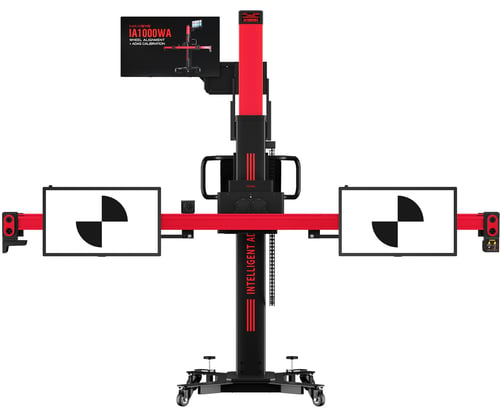
The Autel IA1000 is the most automated system in this comparison.
Its five-way robotic positioning automatically handles forward-facing target placement and fine adjustments involving front-to-back position, vertical and horizontal positioning, pitch, roll and yaw. Six high-definition cameras support optical positioning, while laser guidance assists with Blind Spot, Adaptive Cruise Control and Around View Monitoring pattern placement. The system also incorporates automated unlevel-floor compensation.
For the technician, the biggest difference is how much of the fine positioning the system can manage automatically.
The operator moves the unit into the acceptable positioning range and follows the guided workflow. The IA1000 then performs fine positioning that would require considerably more technician involvement on a manual system.
That can provide two important advantages: repeatability and scalability.
An experienced calibrator can benefit from faster setup and reduced physical effort. But automation can become equally important when a shop wants to train additional technicians and create a process that is less dependent on one person's ability to manually establish calibration geometry.
That does not mean the IA1000 makes training unnecessary.
The technician still needs to understand the vehicle, follow the OEM procedure, prepare the calibration environment correctly and verify the completed work. Automation reduces certain opportunities for setup variation. It does not replace technical knowledge or quality control.
The IA1000 also provides complete wheel-alignment capabilities, allowing a shop to incorporate alignment inspection, adjustment and ADAS calibration into one system and workflow.
For shops selecting the appropriate package, optional digital target monitors add another layer of efficiency. Supported calibration targets can be displayed automatically rather than requiring the technician to retrieve and mount every physical board. Autel also uses over-the-air updates to expand supported digital target coverage.
That can reduce target handling and storage requirements while simplifying setup.
The tradeoff is investment.
The IA1000 makes the strongest business case when a shop can actually use the automation it is buying. A facility performing only occasional calibrations may have difficulty turning those efficiency gains into sufficient additional revenue.
A high-volume collision center, dealership or calibration business is different. If automation allows more work to flow through the same bay, reduces setup time, makes technician onboarding easier and allows more alignment work to remain in-house, the calculation changes considerably.
That is why we recommend evaluating ADAS equipment based on workflow and utilization rather than purchase price alone. Our article on how to forecast ROI on ADAS calibration equipment provides a framework for looking at volume, efficiency and realistic utilization when evaluating the investment.
Best fit: A high-volume collision center, calibration center, dealership or repair operation that values automation, repeatability, integrated alignment and the ability to standardize the workflow across multiple technicians.
Need help finding the right ADAS frame? Use our free ADAS Equipment Advisor.
Key Factors in Your Equipment Selection
Mobility and Shop Space
If true portability is the priority, the MA600 is the clearest choice.
The IA700 retains shop-to-shop and bay-to-bay mobility while adding optical positioning and a more structured setup process.
The IA900 and IA1000 are better viewed as in-shop production systems. Their value comes from creating a repeatable calibration and alignment workflow around the equipment rather than transporting the system between customer locations.
Technician Effort and Repeatability
One of the clearest differences among the four systems is how much of the setup remains in the technician's hands.
The MA600 relies most heavily on manual measurement and adjustment.
The IA700 introduces optical positioning while preserving portability.
The IA900 uses camera-based positioning and robotic frame movement to make an experienced technician faster.
The IA1000 goes further by automating much of the fine positioning associated with forward-facing calibrations and adding laser-guided assistance for several other calibration procedures.
None of that means the more manual systems are inherently less accurate.
A properly trained and precise technician can perform excellent work with an MA600 or IA700. The difference is the amount of technician time and technique required to achieve the correct setup consistently.
Daily Throughput
Volume should have a major influence on the decision.
A shop performing a few calibrations each week may gain relatively little from paying for maximum automation.
A calibration business trying to process multiple vehicles every day can face a very different equation. Several extra minutes of setup per calibration can accumulate into hours of technician time over a week or month.
That is why equipment price should always be evaluated alongside capacity.
How much work are you performing today? How much are you currently subletting? How much additional work could you realistically keep in-house? And how much technician time will each system require to process that volume?
Those numbers will tell you considerably more than the frame price alone.
Wheel Alignment
Alignment creates one of the clearest dividing lines in the comparison.
The MA600 is focused on ADAS calibration.
The IA700 adds an alignment pre-check so technicians can verify whether the vehicle is within specification before calibration.
The IA900 and IA1000 can incorporate complete four-wheel alignment into the workflow when the shop has the appropriate configuration and supporting equipment.
Technician Training and Turnover
More automation can also change how easily the workflow is standardized.
A skilled technician who understands calibration geometry can work very effectively with any of these systems. But a business that depends almost entirely on one highly experienced operator also has an operational vulnerability.
As more positioning tasks become guided or automated, the shop may find it easier to train additional technicians and create a repeatable process.
That is particularly relevant for high-volume operations and multi-location organizations.
Regardless of the frame, however, ADAS calibration still requires proper training, access to OEM procedures and a disciplined quality-control process.
Investment and Growth
There are two easy mistakes to make when selecting equipment.
-
Buying too much system for the work you actually perform.
-
Buying too little system for the business you are trying to build.
A mobile glass company may never benefit from the capabilities of an IA1000. Conversely, a high-volume collision center may save money on the initial purchase of a more manual system only to lose that savings later through technician time and limited production capacity.
The better comparison is total workflow: equipment investment, technician labor, expected calibration volume, target and software requirements, available space, alignment opportunity and future growth.
Which Autel Calibration Frame Should Your Shop Choose?
Bringing ADAS calibration in-house can help your shop handle more work, improve turnaround times, and generate new revenue. But with so many frames and packages available, knowing where to begin can be challenging. That’s why we created the online ADAS Equipment Advisor! Answer a few simple questions about your shop, vehicles, workflow, and goals. In roughly 60 seconds, you’ll receive:
- A recommended Autel ADAS frame and package tailored to your specific operation.
- An estimated starting price, so you can plan with greater confidence.
- Helpful videos and resources to guide your next steps.
Choose for Today, but Plan for Tomorrow
The MA600 can be an excellent platform for a mobile or lower-volume business. The IA700 brings optical assistance into a flexible and transportable system. The IA900 can become a highly productive calibration and alignment platform for an established in-shop operation. And the IA1000 can help a high-volume business reduce setup effort and create a more automated, repeatable workflow.
Choose a system your team can use accurately, consistently and profitably, while giving the business enough capability to support where you expect your calibration work to go next.
If you are still unsure which system fits your operation, we can help you compare your available space, vehicle mix, calibration volume, alignment needs and growth plans before you make the investment.
Topics:
