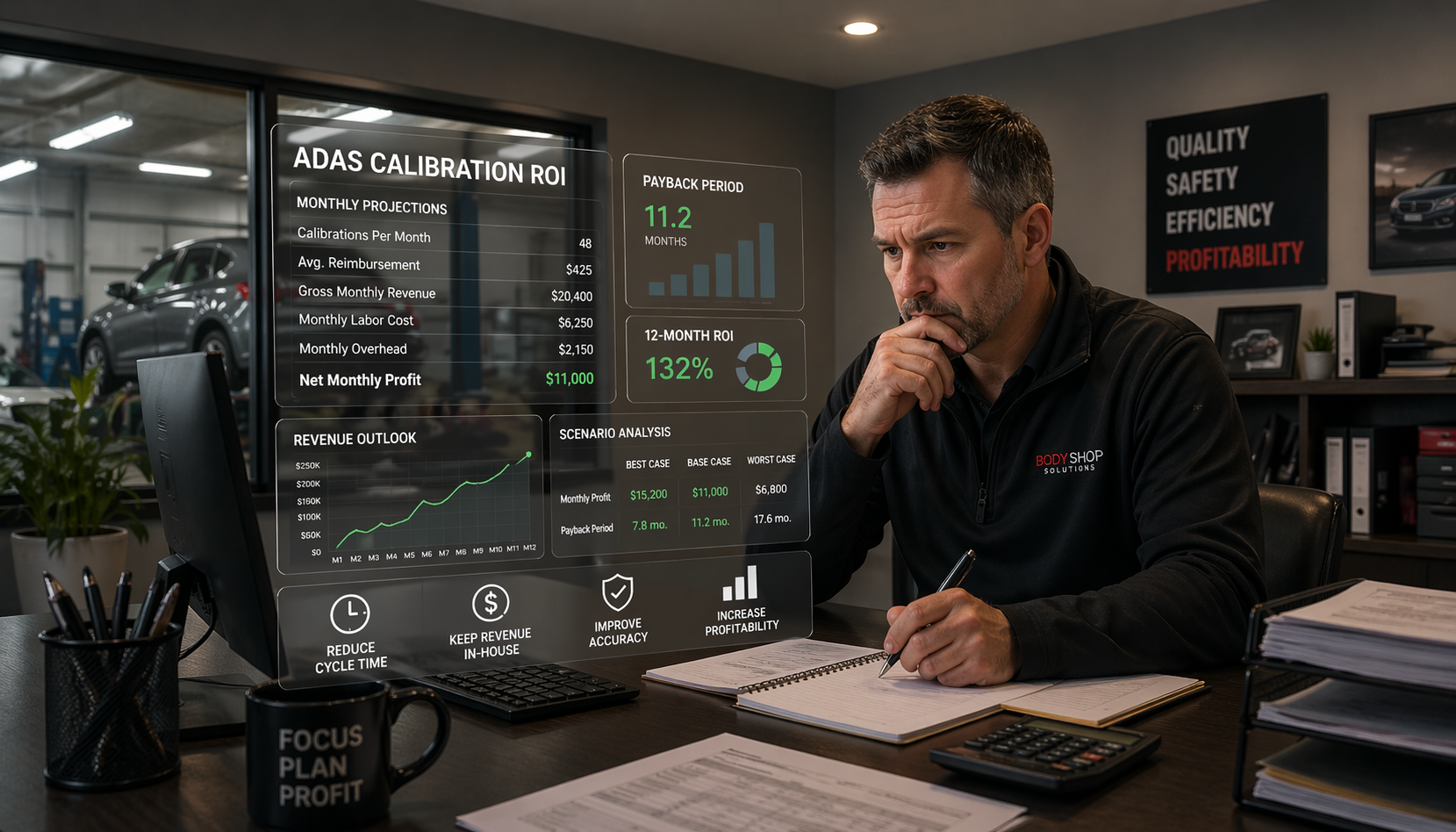
“How fast will this system pay for itself?”
It is one of the most common questions body shop owners ask when evaluating ADAS calibration equipment. It is also one of the most commonly miscalculated.
Too often, ROI projections are built around best-case assumptions. Shops estimate high calibration volume, assume consistent reimbursement, and overlook the operational realities that affect throughput and cost. The result is a forecast that looks strong on paper but fails to hold up in practice.
The truth is simple. ADAS ROI is not driven by equipment price alone. It is driven by how often the system is used, how efficiently calibrations are completed, and how well the operation is structured to support it.
Industry voices continue to reinforce the growing importance of calibration as a core repair function, while also providing helpful guidance for shops evaluating the investment. Resources like Bringing ADAS Calibration In House- A Complete Guide for Shop Owners and Is In-House ADAS Calibration Worth It? Try An ROI Calculator may prove especially useful as you think through your approach. The ROI is there. The key is taking a close look at how calibration will flow through your operation so you can forecast it as clearly and accurately as possible.
This article will walk through a practical framework to forecast ROI based on real numbers, not assumptions.
Need help finding the right ADAS frame? Use our free ADAS Equipment Advisor.
ROI Is Built in the Workflow
On paper, ADAS calibration looks straightforward. A few calibrations per day at a few hundred dollars each, and the investment starts to make sense quickly.
In the real world, volume is tied to how vehicles move through the building. Calibrations get delayed. Sublet work disrupts scheduling. Technicians make judgment calls that may or may not be consistent. Small inefficiencies compound.
Two shops can have the same car count and the same opportunity. One builds a reliable, profitable calibration process. The other ends up frustrated, wondering why the numbers never quite add up.
The difference is not the equipment. It’s how the work gets done.
Start with What Is Already Happening
Before projecting future revenue, it helps to take a clear look at the present.
Most shops are already dealing with calibration every week. It shows up in sublet invoices, in delays waiting on third parties, and in vehicles that require additional steps after repairs are complete.
When you step back and look at recent repair orders, a pattern usually emerges. Calibration is already part of the business. It just isn’t controlled.
That matters more than most forecasts acknowledge.
Bringing calibration in-house is not about creating something new. It is about taking ownership of something that is already happening and building a process around it.
Volume Is More Predictable Than It Seems
One of the biggest surprises for shop owners is how consistent calibration demand actually is once they start tracking it correctly.
It is easy to overestimate by assuming every possible calibration will come through the door. It is just as easy to underestimate by overlooking how often it is already required. The truth usually sits somewhere in the middle, and it is far more stable than expected.
When shops base ROI on real repair data instead of assumptions, the picture becomes clearer. Not perfect, but grounded. And that is what you need for a reliable forecast.
Efficiency Turns Opportunity into Profit
Even with solid volume, profitability depends on how efficiently calibrations move through the shop. Without structure, they interrupt production. They create bottlenecks. They get pushed to the side when things get busy.
With structure, they become part of the normal flow of work.
That shift does not come from the tool itself. It comes from having a defined process. Vehicles are staged correctly. The space is set up to support the work. Technicians understand the steps and follow them consistently.
When that happens, calibration stops feeling like an add-on and starts functioning like a standard operation.
Time Is Often Underestimated
Another common gap in forecasting is how long calibration actually takes. Not just the scan, but everything around it. Vehicle setup matters. Environment matters. Target placement matters. Documentation matters.
Shops that treat calibration like a quick add-on tend to run into frustration. Jobs take longer than expected. Schedules slip. Confidence drops.
Shops that plan for the full process build consistency instead. And consistency is what allows time to be managed, improved, and eventually optimized.
Speed comes later. Control comes first.
The Costs That Don’t Show Up in the Quote
It is easy to focus on the purchase price of the equipment. It is harder, but more important, to think about the full picture.
There are ongoing elements to any calibration program. Software updates. Training. technician time. Space in the shop that needs to be dedicated and maintained.
These are not hidden problems. They are part of building a real capability.
When shops acknowledge them early, ROI forecasts become more accurate. And more importantly, more achievable.
The Gains Most Shops Don’t Measure
Some of the strongest returns from in-house calibration are not captured in a simple calculation.
Cycle time improves when you are no longer waiting on sublet providers. Scheduling becomes more predictable. Communication gets simpler. Documentation stays under your control.
There is also a confidence factor that is harder to quantify but easy to feel. Technicians know the job was completed correctly. The shop is not relying on outside variables to finish a repair.
Over time, these gains add up. They shape how the business runs, not just how a single service performs.
Pressure-Testing the Forecast
A good ROI forecast should hold up under realistic conditions, not ideal ones.
What happens if volume comes in a little lower than expected? What happens if certain jobs take longer? What happens when the shop gets busy and priorities shift?
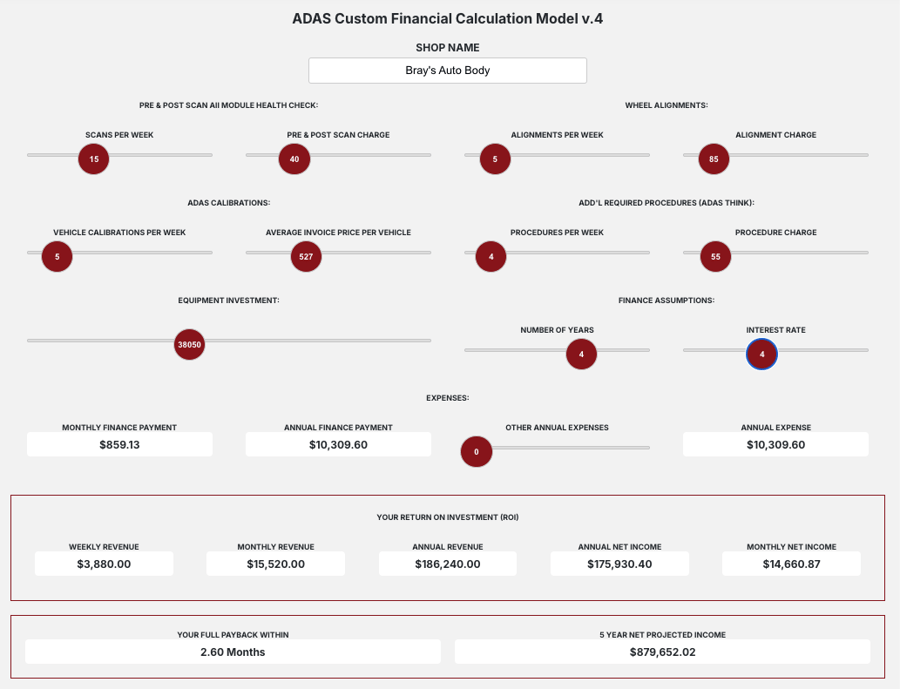
If the numbers still make sense under those conditions, the forecast is probably sound. If they only work when everything goes perfectly, it is worth taking another look. You can also model your forecast using our online ROI calculator to see how these variables impact your numbers.
A More Practical Way to Look at ROI
Industry coverage continues to reinforce the growing importance of calibration as a core repair function. It also highlights the reality that doing it correctly requires more than equipment alone.
These additional resources may prove helpful as you evaluate your own situation. The ROI is there, but it depends on how well the work fits into your operation.
Shops that approach calibration as a disciplined process tend to see consistent results. Shops that treat it as an occasional add-on tend to struggle.
The Bottom Line
ADAS calibration can absolutely become a profitable part of your business. But it does not happen automatically.
It comes from building a process that works every day. One that your team understands, trusts, and can repeat without hesitation. When that happens, ROI stops being a projection and starts showing up in the way your shop operates.