How does a shop know if it’s ready to bring ADAS calibration in-house? For most, the answer comes down to a few practical business considerations:
- The cost of the equipment
- How much calibration work is likely to flow through the shop
- How long it may take to move from break-even to a dependable, growing revenue stream
Here at Applied Automotive Technology (AATI), we work closely with body shops that regularly sublet ADAS calibration work to us. Each month, we perform more than 50 real-world calibrations on behalf of shops that lack the in-house technology to complete them themselves.
That day-to-day exposure gives us a grounded view of where the real business opportunity exists, and whether a shop like yours should take the leap and bring ADAS calibration in-house.
It also allows you to model how calibration volume ramps up over time and which financial assumptions have the greatest impact on ROI.
By the end of this article, you’ll be better prepared to evaluate the investment. When you’re ready, you can try our AATI ROI Calculator to see how the numbers work for your shop.
Need help finding the right ADAS frame? Use our free ADAS Equipment Advisor.
First Step: Your ADAS ROI Calculator
Most shops underestimate how much ADAS-related work they already touch, or will touch soon. Sublets go out the door every week, but the true opportunity often isn’t tracked. Without that visibility, the investment can feel riskier than it actually is.
An ROI calculator helps bring clarity in several important ways.
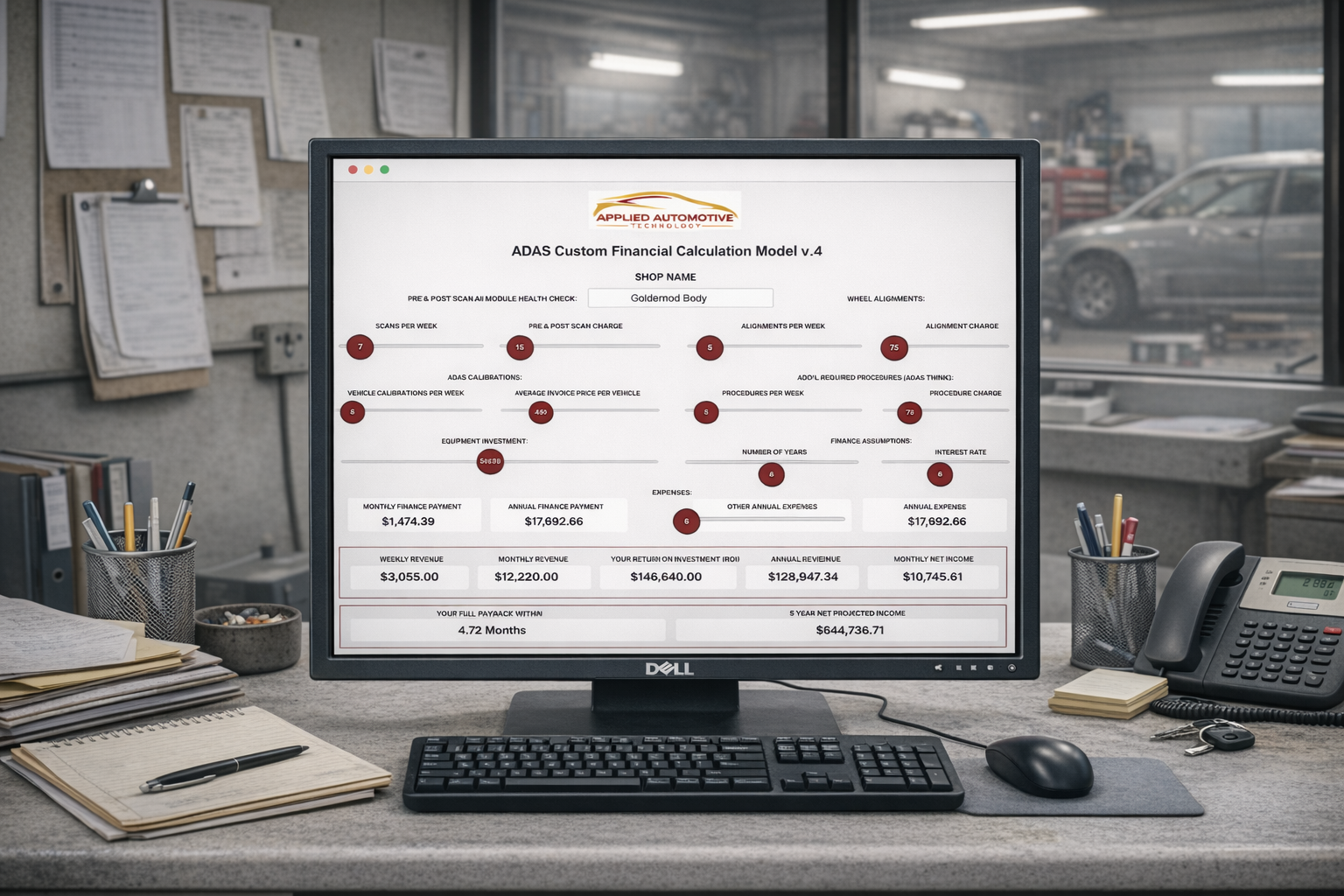
It shows your real weekly and monthly revenue based on work already happening in your bays, or likely to flow into them. It also reveals net income after equipment payments and expenses. Finally, it clarifies your payback period and longer-term income outlook.
An ROI calculator also lets you explore multiple scenarios. You can look at conservative, moderate, or future volume levels. This helps you see how changes in workflow and services performed affect ROI over time.
That clarity changes the conversation.
Instead of asking, “Are we ready?” shops can say, “Here’s where we stand, and here’s when this pays for itself.”
3 Key Inputs That Reveal Your ADAS Profit Opportunity
While the calculator includes several fields, most results depend on three workflow inputs:
- Wheel alignments
- ADAS calibrations
- Additional required procedures
These are services your shop already performs, or will reasonably perform, as your repair mix evolves.
1. Wheel Alignments Per Week
ADAS calibrations often require alignment checks. These typically bill around $60. In many cases, those checks lead to full alignments billed closer to $120.
Even a small number of alignments each week can improve the financial model. Over time, that additional revenue adds up and shortens the payback period.
2. ADAS Calibrations Per Week
This is the centerpiece of the model. Even one or two calibrations per week can offset a meaningful portion of the equipment cost. Three to five calibrations per week often put shops on a fast path to payback.
It’s also important to look ahead. Independent shops typically repair vehicles that average 12 to 14 years old. Many of those older vehicles had limited ADAS features.
That is changing. As 2020 and newer vehicles enter the same repair cycle, the number of sensors and safety systems increases. As a result, calibration demand rises. For many shops, today’s numbers represent only the beginning of future opportunity.
3. Additional Required Procedures
Once calibration work begins, other OEM-required procedures often follow. These may include:
- Steering angle sensor calibration
- Seat weight sensor verification
- Power liftgate relearns
Including these steps in the calculator helps account for the full scope of work. It also helps capture the full revenue tied to ADAS calibration.
How the Calculator Builds the Financial Model
After workflow numbers are entered, the calculator factors in:
- Equipment price
- Financing term length
- Interest rate
From there, it shows weekly and monthly revenue, along with expected payback.
Interest often gets early attention. It only becomes a concern when debt does not generate income. With ADAS calibration, the equipment produces revenue. Because inputs are adjustable, the calculator also shows how results change at 6, 12, and 24 months as volume grows.
A Realistic Shop Scenario
Many shops are surprised when they see their ADAS revenue displayed in one place. Once they do, the opportunity becomes clear.
Net monthly income shows what remains after expenses. In many cases, it is stronger than expected. The payback period is often the biggest “aha” moment.
One real example comes from a shop that invested about $60,000 in equipment. That shop generated roughly $20,000 per month in ADAS revenue. The equipment paid for itself in just three months.
Breaking the work down helps make the picture clearer. A typical week might include:
- 3 alignments
- 3 to 5 calibrations
- 3 to 5 additional required procedures
With an equipment payment of around $1,100 per month, this level of activity often produces solid net income, a comfortable payback timeline, and strong long-term projections. Even lower-volume shops frequently find the numbers work in their favor.
Why the 5-Year ADAS View Matters
According to KPMG, the North American ADAS calibration services market was estimated at about $1.2 billion last year. It could grow to nearly $3 billion annually by 2030 as ADAS-equipped vehicles become more common.
This growth helps explain why five-year projections are often strong. Today’s calibration volume reflects early adoption. Demand increases steadily as newer vehicles age into independent repair and collision work.
Common ROI Mistakes and How to Avoid Them
One common mistake is guessing at the numbers. Using optimistic weekly averages can make the math look better than it really is and create expectations the shop can’t support.
Another issue is overlooking technician time. When a technician spends hours fixing a failed calibration, the cost is more than just wages. That time could have been used on other paying work.
Finally, some shops underestimate how ready their workflow really is. Even a strong financial case can fall apart if the space isn’t set up properly. Floor space, lighting, and clear technician responsibility all matter. Confirming those basics first helps ensure ROI projections reflect what the shop can actually support.
The Bottom Line: Turning the Numbers Into a Decision
If weekly ADAS calibration revenue exceeds weekly equipment cost, the investment in calibration equipment makes smart financial sense. If bringing calibration in-house reduces sublets and improves control, the value increases. And if the payback timeline fits your comfort level while long-term projections align with where your shop is headed, the decision becomes much clearer.
This article is designed to guide you through the business case. When you’re ready, our AATI ROI Calculator allows you to test real-world scenarios and see how the numbers play out. If you’d like a second set of eyes on your inputs or payback timeline, we’re happy to take a look with you.