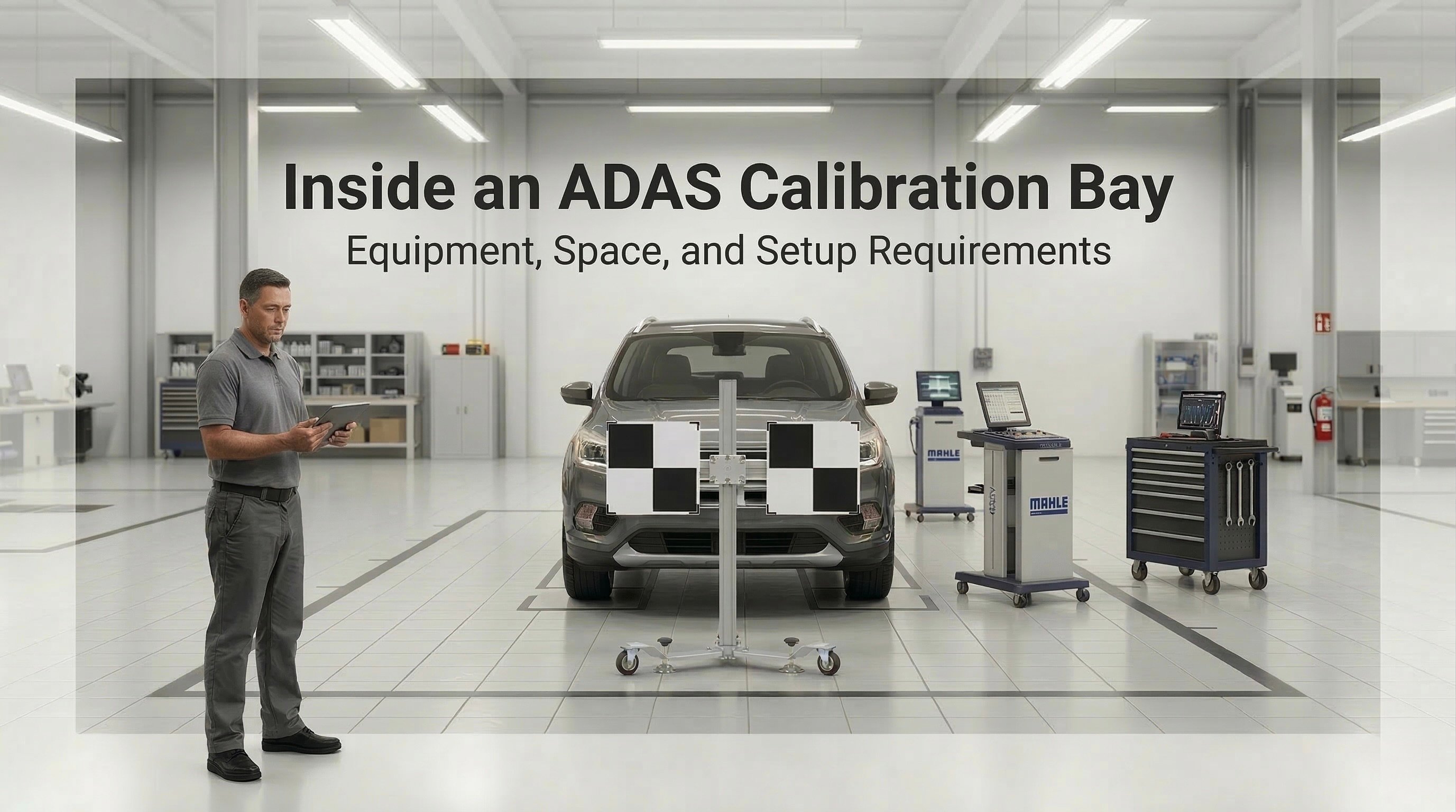
If your collision repair shop is tired of subletting work, losing control of cycle times, and watching profits leave on a flatbed, you are likely looking to bring ADAS calibration in-house. However, purchasing a frame and a diagnostic tablet is only the first step. Setting up a highly functional calibration bay requires precision and a properly controlled environment. If you attempt calibrations in an uncontrolled, cluttered environment, you risk failed calibrations, comebacks, and significant liability. You need to know exactly what a dedicated space requires before making a major capital investment.
We have gone through the ADAS learning curve alongside the shops we serve. Our team has evaluated countless body shop bays, trained hundreds of technicians on real collision-repaired vehicles, and seen exactly what causes a shop to struggle or succeed.
Need help finding the right ADAS frame? Use our free ADAS Equipment Advisor.
In this article, you will learn the space requirements, floor levelness, lighting, and tool requirements for setting up an ADAS calibration bay. By the end of this article, you will have a clear, step-by-step understanding of how to build a profitable, in-house calibration space that keeps your technicians efficient and your customers safe.
What Space Do I Need?
ADAS calibration requires a dedicated, controlled space, not just an open spot on the shop floor. Most forward-facing calibrations require as little as 10 feet of clear space in front of the vehicle, allowing many procedures to be completed in a 16' × 30' repair bay, while nearly all system calibrations can be performed within a 24' × 34' area with limited vehicle repositioning.
When you try to calibrate a forward-facing camera or a blind-spot radar system in a cluttered area, the vehicle’s sensors can pick up background noise. Toolboxes, other moving vehicles, and even technicians walking by can interfere with the radar signals or camera targets.
As highlighted in a detailed breakdown of ADAS calibration requirements by CarADAS, failing to manage these environmental factors—including background clutter, wall colors, and uneven lighting—directly causes sensors to read inaccurate data or fail to recognize targets altogether.
This lack of process discipline leads directly to measurement inaccuracies. If an ADAS system is calibrated improperly, the vehicle’s automatic emergency braking or lane-keep assist will not function correctly on the highway. Proper bay setup protects both your customers’ safety and your shop’s liability.
How Flat Does the Floor Need to Be for ADAS Calibration?
When shop owners consider bringing calibration in-house, one of the first questions is about floor space and levelness. Historically, alignment and calibration required perfectly level floors, which often meant expensive concrete work that damaged profitability before the first calibration was even performed.
Today, modern calibration frames, such as the Autel’s highly capable IA700, IA900WA, and the IA1000, are much more forgiving. The software within these systems can help compensate for an uneven floor. In fact, modern systems can adjust for up to four degrees of slope. For example, if your bay floor slopes slightly down toward the garage door for drainage, the system can calculate that angle and compensate for it during the calibration process.
However, you still want the flattest space possible to ensure repeatable accuracy. When outfitting your bay, you also need to decide whether to calibrate on the ground or on a lift. If you choose to add a lift to your calibration bay, a recessed lift is the ideal choice, although it is a more expensive investment. Sometimes, your technicians must remove a belly pan from underneath the vehicle to access a radar sensor. Having a lift makes this process significantly easier and keeps your workflow moving efficiently.

What Kind of Lighting Does an ADAS Calibration Bay Need?
Lighting directly impacts camera calibration accuracy. A common misconception is that a bay should be as bright as possible. In reality, too much light can be just as problematic as too little light.
If sunlight is beaming directly onto the calibration target or into the vehicle’s windshield, the vehicle’s camera can get washed out. It may fail to recognize the target pattern, leading to a failed calibration. To prevent this, the lighting in the bay needs to be controlled. In many shops, the solution is simple—installing curtains, shades, or blinds on nearby windows to block direct sunlight and maintain consistent lighting conditions during the calibration process.
Switching to dimmable LED lighting is one of the smartest upgrades you can make. If you notice glare on the target, you can easily dim the lights to help the camera read the pattern. Additionally, older and modern calibration setups often require the use of center-line lasers on the ground to align the frame to the vehicle. Dimming the room makes it much easier to see these lasers, reducing setup time and technician frustration.
Why Does an ADAS Calibration Bay Need Reliable Wi-Fi?
A highly functioning ADAS bay must have reliable internet access. When connecting to the vehicle through the Data Link Connector (DLC), the scan tool often needs to communicate with OEM databases to retrieve procedures, software updates, and calibration instructions. In many modern vehicles, the manufacturer has also placed a secure gateway between the scan tool and the vehicle’s systems. Accessing certain functions—including ADAS calibrations—requires the scan tool to connect to the internet to authenticate and unlock that gateway through the OEM’s system before the calibration process can proceed.
Your frames are equipped with Wi-Fi to pull the most up-to-date OEM repair procedures, download software updates, and complete the digital reporting process. Without a strong internet connection in your bay, your technicians will struggle to finalize the calibration reports, destroying your cycle time and efficiency.
Beyond the Frame: Necessary Bay Tools
Most shops focus heavily on the calibration frame itself, but the daily work of ADAS calibration requires standard hand tools. When you set up your bay, you should dedicate a specific tool cart to this area.
Your technicians will need a basic set of tools, including screwdrivers, wrenches, and sockets. More importantly, they will need plastic body inserts and trim removal tools. Calibrating radar modules often requires popping off plastic bumper covers or plastic retainers to expose sensors. If your mobile or dedicated calibration tech has to constantly walk across the shop to borrow standard hand tools, you are losing money on wasted time. Make sure your calibration bay has its own fully stocked toolbox.
Storage and Organization
As you acquire more targets, radar reflectors, and tools for different vehicle makes, your bay can quickly become cluttered.
You can purchase add-on storage solutions, such as wall-mounted brackets or rolling storage cases that attach directly to the sides of your calibration frame. These storage cases are large enough to hold your printer, diagnostic tablets, and additional alignment tools. Keeping everything organized in one place ensures your technicians are turning wrenches and calibrating cars, rather than searching for a missing target in a silver flight case.
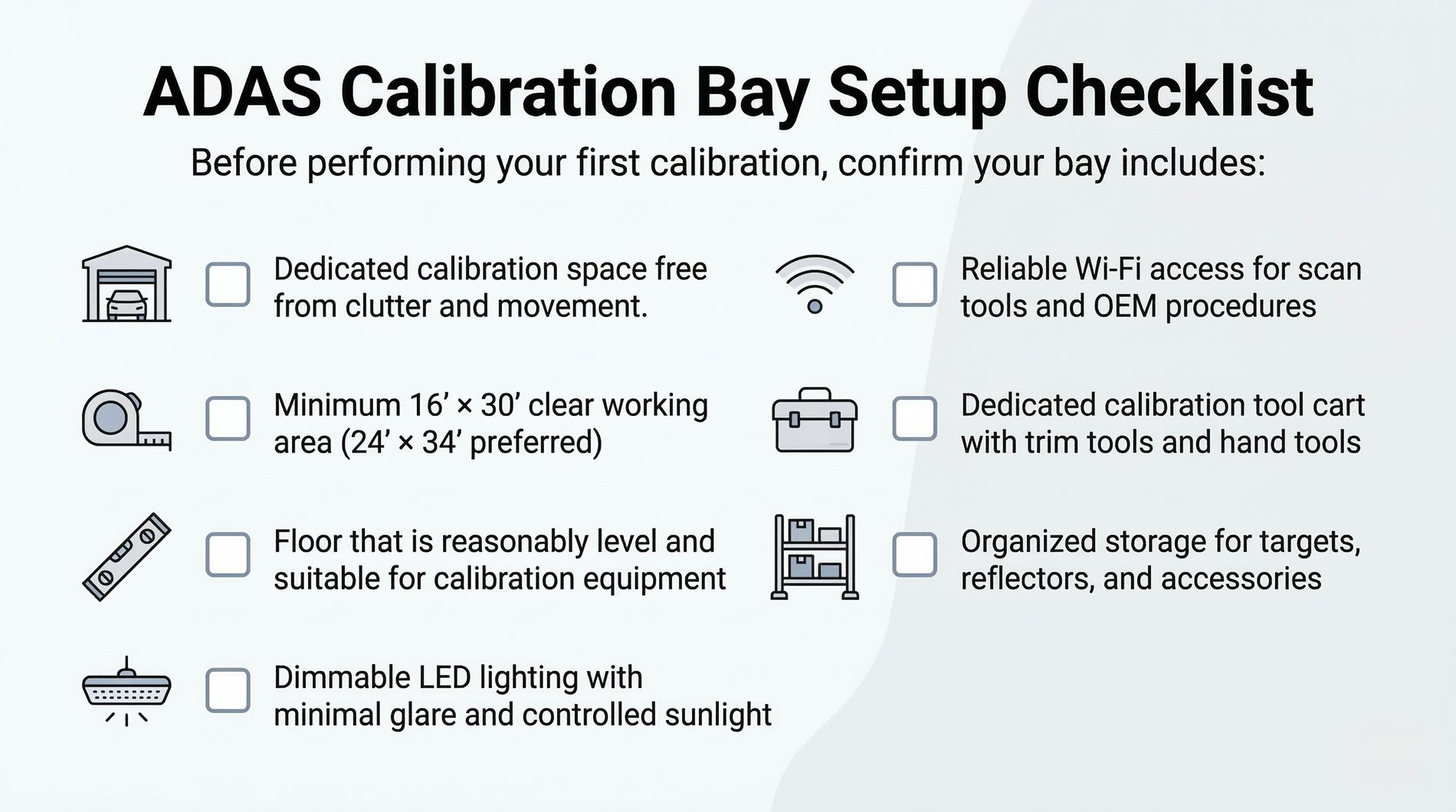
Use the checklist below to quickly confirm your calibration bay meets these requirements.
Bring Calibration In-House With Confidence
Setting up an ADAS calibration bay can feel overwhelming, but proper planning solves most problems before they start. When you evaluate your space, control your lighting, ensure strong Wi-Fi, and equip your technicians with dedicated hand tools, you set your shop up for immediate success.
ADAS can be complex and confusing, but we can help make it simple. We pair industry-leading Autel equipment with hands-on training and lifetime support so your shop can calibrate accurately, reduce cycle time, and grow profitably. You are not just buying a tool; you are gaining a partner who will help you maximize your return on investment.
To see exactly what that return looks like for your specific business, try our ADAS ROI calculator. This tool allows you to model your potential profits based on your unique shop, daily workflow, and equipment investment, giving you a clear picture of the financial opportunity before you spend a dime.
If you are ready to stop subletting, take control of your repair quality, and build a highly profitable service line, we are here to help. Schedule a consultation with our team today. We will help you evaluate your current space, select the right equipment, and build a workflow that makes your technicians confident, capable, and profitable.