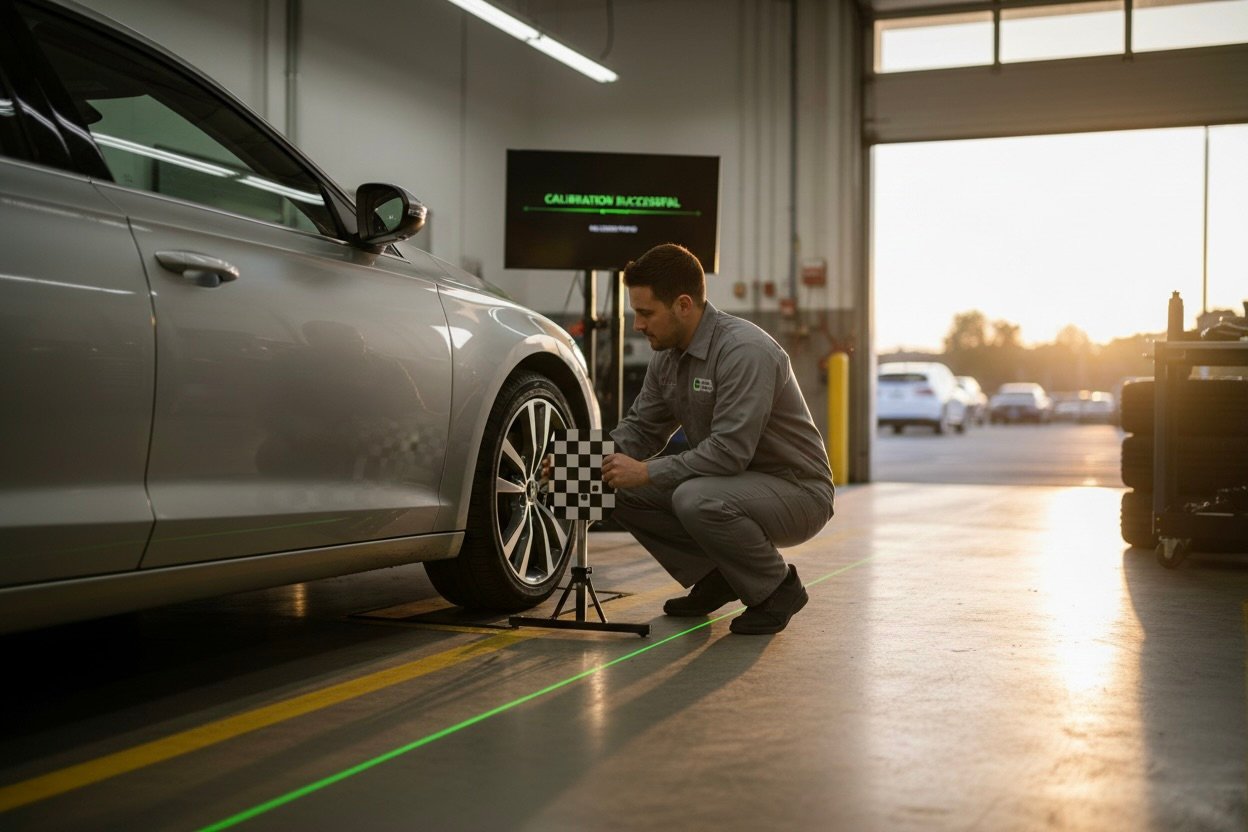
A “Calibration Complete” message can feel like the finish line. The scan tool displays success, warning lights are cleared, and the vehicle appears ready for delivery. But in the world of ADAS, pass does not always mean safe.
ADAS miscalibration is rarely caused by equipment failure alone. In most cases, it begins long before the targets are placed. It starts with a bent bracket that was never corrected, a vehicle that is not truly in curb state, environmental conditions that were overlooked, or a rushed setup that introduces small but critical measurement errors.
These are not dramatic mistakes. They are subtle ones. And subtle errors are often the most dangerous.
We at Applied Automotive Technology have worked alongside body shops for more than a decade and perform calibrations every week. We have seen where calibrations succeed on screen but fail in the real world.
Below, we break down five key reasons miscalibrations actually occur and how a disciplined, repeatable process eliminates rework, reduces liability, and protects both your customer and your shop.
Need help finding the right ADAS frame? Use our free ADAS Equipment Advisor.
What Is ADAS Miscalibration?
First, let’s make sure we’re all on the same page.
ADAS miscalibration, sometimes referred to as a "ghost calibration," occurs when a system completes its software procedure but the physical alignment of the sensor is not accurate to real-world driving conditions.
A scan tool may show success. Codes may be cleared. But the vehicle’s understanding of the road can still be inaccurate. The system recognizes the calibration target and completes the software process. Yet the sensor may still be physically out of alignment due to an issue the scan tool cannot detect.
Consider a camera that is tilted just one degree because of a slightly bent mounting bracket. During static calibration, the software may still lock onto the target and confirm completion. To the technician, the job appears finished. But at highway speeds, that one-degree tilt can translate into a deviation measured in dozens of yards down the road.
The vehicle may leave the shop without warning lights — yet its forward-facing systems are operating outside of OEM specification.
Industry publications are increasingly acknowledging this risk. In the August 2024 issue of Hammer & Dolly, the feature Beyond What the Eyes Can See: Common ADAS Mistakes and How to Avoid Them reinforces how environmental and physical setup errors frequently escape detection by scan tools.
This is not random. And it is not unavoidable. When miscalibration occurs, it can almost always be traced to specific, preventable breakdowns in procedure.
The 5 Most Common Causes of ADAS Miscalibration
While every shop is different, the root causes of miscalibration are remarkably consistent. In our experience working alongside body shops across the country, these are the five most common causes:
- Shop Environment Setup Issues
- Vehicle Not in Proper Curb State
- Stacking Errors from Rushed Execution
- Overreliance on Scan Results
- Skipping Dynamic Verification
Let’s break each one down in more detail.
1. Shop Environment Setup Issues
Many calibration failures stem from the shop environment rather than the equipment.
If the shop floor has even a minor drainage slope or uneven surface, the vehicle and the targets may sit on different planes. That changes sensor aim before the process even begins. “Level enough” is not precise enough for modern ADAS systems.
Lighting is another silent variable. Direct sunlight, flickering LED fixtures, open bay doors, or reflections off windshields can interfere with camera-based systems. A window left uncovered can introduce ambient light that distorts target recognition. Radar systems can be affected by large metal objects behind or near the target. A toolbox placed in the wrong position can introduce reflection or interference.
The Hammer & Dolly article above highlights how these “invisible” environmental variables are among the most common contributors to failed or inaccurate calibrations. The equipment may be functioning perfectly. The environment may not be.
2. The Vehicle Is Not in Proper ‘Curb State’
Before a technician ever touches a scan tool, the vehicle must be in proper curb state — the exact physical condition it would be in during normal driving. Skipping these foundational checks is one of the most common causes of calibration drift.
Key fundamentals:
- Pre-Scan Baseline:
Perform a complete pre-scan to establish the vehicle’s electronic condition before calibration begins. This identifies existing faults, confirms module communication, and creates a documentation baseline. - Tire Pressure and Ride Height:
A single underinflated tire changes the pitch of the entire vehicle. If the vehicle is not level, the sensor aim is incorrect before targets are even placed. - Fuel Load Requirements:
Many OEM procedures specify a full tank of fuel during calibration. The weight of 15 to 20 gallons affects suspension compression and ride height. Ignoring this requirement alters sensor positioning. - Mechanical Alignment First:
ADAS cannot be calibrated accurately on a vehicle with thrust angle errors or improper alignment. If the vehicle is dog-tracking due to alignment/thrust angle issues, sensors may interpret lane position incorrectly. - Component Integrity and Quality Materials:
Calibration accuracy depends on the integrity of mounting surfaces, brackets, sensors, and glass. OEM-specified components and proper installation are essential to maintaining correct sensor alignment. Industry experience has shown that lower-cost replacement glass can introduce subtle optical distortion that prevents forward-facing cameras from calibrating properly.
When these fundamentals are overlooked, calibration drift is not a software issue. It is a setup issue.
3. ‘Stacking Errors’ from Rushed Execution
In precision engineering, “stacking errors” occur when multiple small, seemingly insignificant mistakes add up to a major failure. A technician may be slightly off on centerline. The target may be placed slightly too close. The floor may have minor pitch. Individually, each deviation seems insignificant. Together, they create a meaningful shift in sensor aim.
This concept has been highlighted at the industry level as systems grow more complex. In the September 2021 issue of AASP-MN News, the article The Age of ADAS: Realities, Recommendations, and Roadblocks explains how manual measurement variances lead directly to safety risks. https://aasp-mn.org/news/
The article reinforces the human factor behind calibration accuracy. If a technician is off by just 2mm on a centerline measurement, and the targets are placed several centimeters too close, and the floor has a slight slope, each error compounds. The scan tool may still display a green checkmark because it successfully detected the target. But the cumulative variance means the vehicle’s “vision” is skewed in real-world conditions.
The AASP-MN report also notes that these roadblocks are often what prevent shops from being both profitable and safe. Manual setup mistakes are not just technical oversights. They are liability exposure points.
4. Overreliance on Scan Results
“No codes” does not mean “no problem.”
It is common for a vehicle to arrive with dozens of stored codes after disassembly. That is normal. What matters is which codes clear and which remain.
We have encountered situations where non-ADAS modules prevented calibration from completing properly. In one case, a vehicle required headlight programming before the camera calibration could finalize. The radar calibration completed. The camera would not. There were no obvious ADAS faults. But the adaptive headlight system was electronically tied into the camera’s functionality, and until it was programmed correctly, calibration could not succeed.
Modern vehicles are networked systems. Calibration cannot be viewed in isolation. A clean scan report is necessary, but it is not proof of proper physical alignment.
5. Skipping Dynamic Verification
Static calibration is often only the first half of the process. Some vehicles require dynamic calibration as a mandatory final step.
Static calibration occurs in a controlled environment using fixed targets. Dynamic calibration requires driving at specific speeds so the system can learn real-world lane markings and traffic behavior. Even if the static setup is perfect, the dynamic drive confirms whether the sensors correctly interpret real-world conditions.
For a detailed explanation of static vs dynamic procedures should be considered and why, see our blog post Static vs. Dynamic ADAS Calibration: Understanding the Difference.
A final post-scan should always follow the dynamic drive to confirm that no new codes were triggered.

Why These Issues Are Often Overlooked
Calibration can feel like a software procedure. Connect the tablet. Place the targets. Follow prompts. Wait for confirmation.
But ADAS calibration is precision engineering layered on top of software. The software cannot detect every physical misalignment. When calibration is treated as a button-pushing event rather than a controlled engineering process, preventable errors occur.
Collision repair is production-driven. Different technicians handle teardown, structural repair, and reassembly. If a bracket is not corrected during reassembly, the calibrator may inherit a physical issue that is not immediately visible.
The Cost of Getting It Wrong
In the automotive industry, we call them comebacks.
No shop wants to rework a vehicle for free. When a calibration must be redone because of a missed step, that technician is not generating revenue. They are correcting something that should have been right the first time.
The greater concern is what happens if the error is not caught immediately. Best case, a warning light returns and the vehicle comes back. Worst case, the system fails during a real-world driving event.
How Shops Can Prevent Calibration Errors
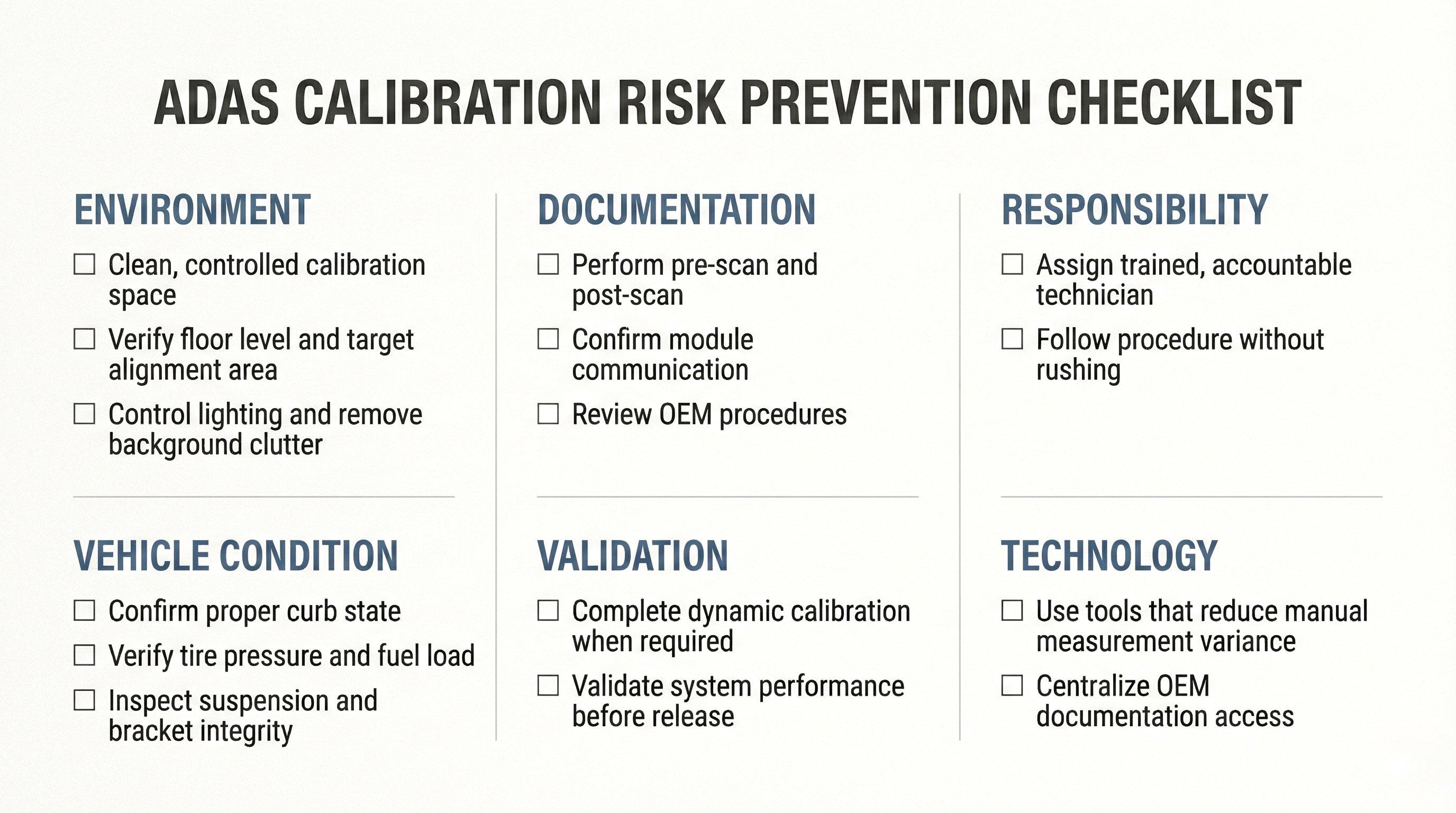
Shops can significantly reduce calibration risk by following a structured checklist:
Reducing Human Variance with Smarter Systems
While a disciplined process is essential, modern calibration technology has evolved to reduce manual setup errors.
Earlier ADAS setups relied heavily on tape measures, plumb bobs, and manual centerline calculations. Each step introduced the potential for measurement variance. As discussed in the stacking error concept, even small deviations compound.
Today, more sophisticated calibration frames use laser-guided positioning, digital measurement verification, and integrated alignment confirmation to reduce reliance on manual estimation. These systems do not eliminate the need for proper procedure, but they significantly reduce the opportunity for human error.
Modern scan tablets also provide a structured, step-by-step workflow that guides technicians through OEM-required procedures. When used correctly, this guided approach acts as a fail-safe framework, helping prevent missed steps and reinforcing procedural discipline.
Beyond the physical setup, ADAS Workflow Software (AWS) tools further reduce risk by pulling OEM position statements, calibration requirements, and manufacturer documentation into one accessible workflow. This makes OEM data easier to access and verify to help ensure technicians are following current manufacturer guidance rather than relying on memory or assumptions.
Master Your Workflow and Protect Your Customers
Most ADAS miscalibrations are not dramatic failures. They are small procedural misses. A bracket slightly off. A tire slightly low. A target slightly mismeasured.
But when those errors stack, the vehicle’s perception of the road changes.
High-performing shops rely on repeatable processes. By standardizing your environment, verifying curb state, and respecting OEM procedures, you move beyond clearing codes. You ensure the safety systems your customers rely on will perform when they are needed most.
If you’d like a deeper look at what ADAS calibration really means for your shop, read The Computer on Wheels: What ADAS Calibration Is and What It Means for Your Shop.
If you would like to review your current calibration workflow or evaluate whether your environment meets OEM standards, our ADAS Experts are available to help you build a process that prioritizes safety, efficiency, and long-term profitability.