As more collision repair shops bring ADAS calibration in-house, attention is often placed solely on the equipment and the revenue potential. What is less discussed is the daily technical and environmental hurdles your calibration technicians face. Returning a vehicle to full safety shouldn't be this hard, yet production pressure, complex scan tools, and setup errors often lead to failed calibrations.
Shop owners are left wondering why a seemingly simple process causes so much frustration, rework, and anxiety on the floor.
At Applied Automotive Technology, we’ve lived the ADAS learning curve. We understand the specific friction points that technicians encounter because we have spent years troubleshooting the exact same problems in our own bays.
In this article, we will clarify the top ten real-world challenges your technicians encounter during calibrations. You will see exactly how environmental variables, equipment setups, and workflow pressures impact your bottom line. By the end, you will know how to support your team, reduce liability, and ensure accurate, safe results.
Need help finding the right ADAS frame? Use our free ADAS Equipment Advisor.
The following ten challenges appear repeatedly when collision centers begin performing calibrations in-house.
1) The "Rocket Scientist" Misconception
The Challenge: Shop owners often assume they need their highest-level diagnostic mechanic, their A-level technician, to perform daily calibrations. This misconception creates unnecessary workflow bottlenecks.
The Solution: You do not need a rocket scientist for routine ADAS work. You simply need someone who is highly tech-savvy and meticulous.
An ideal calibration technician simply needs the ability to:
- Easily navigate a smartphone or tablet interface
- Understand and adapt to modern software applications
- Follow strict, step-by-step instructions without deviation
Bottom Line: Free up your master technicians for deep diagnostic work, and train your detail-oriented staff to handle the scan tools.
2) Environmental and Space Constraints
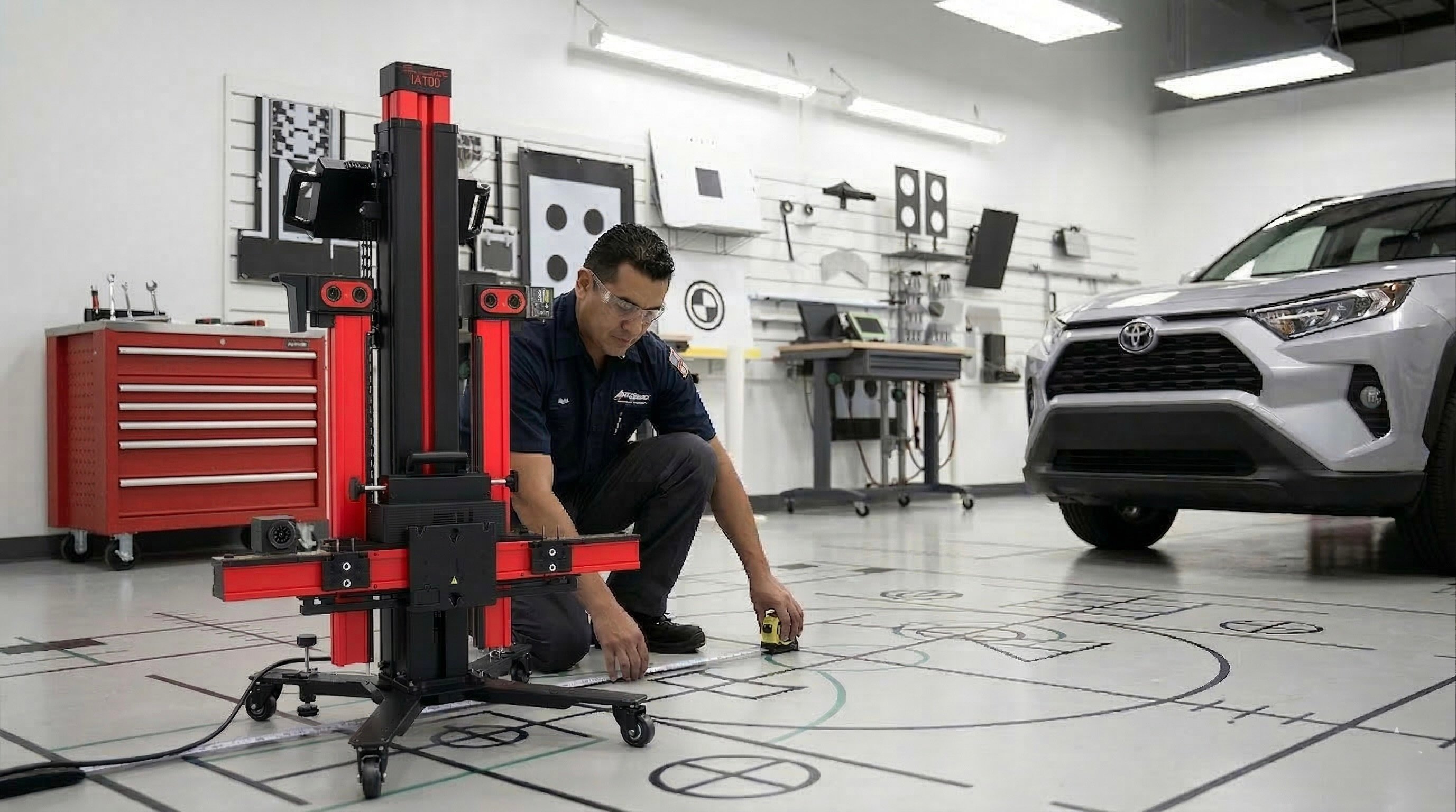
The Challenge: Calibration precision depends entirely on the environment, setup, and process control. A technician can do everything exactly right, but if the facility floor is unlevel or the lighting is uneven, the calibration will fail. Small deviations matter.
The Solution: Dedicated space planning is critical to removing these environmental roadblocks. If your team is fighting the environment, they aren't just scanning a car, they are battling the building.
As noted in ADAS Calibrations: Lessons Learned (BodyShop Business), heavy glare from an open bay door can blind a vehicle's camera, just as dark shadows can hide a target.
Bottom Line: Calibrations performed in cramped or uncontrolled environments are far more likely to fail.
3) Repetition Breeding Complacency
The Challenge: ADAS calibration is a highly structured, repetitive process. Over time, performing the same steps repeatedly can lead to natural complacency. A technician might accidentally mount the left-front wheel target on the right-rear wheel, or place a distance target from memory instead of verifying the measurement with a tape measure. Even small lapses in process discipline can compromise calibration accuracy.
The Solution: Treat every calibration as a fresh setup. Technicians must follow the OEM procedure step-by-step for each vehicle, verifying measurements and target placement every time rather than relying on memory or habit.
Bottom Line: Consistency and discipline are essential. Every calibration must be executed with the same careful attention, no matter how many times the technician has performed the procedure before.
4) Skipping Critical Pre-Scan Preparations
The Challenge: Not every failed calibration is caused by the equipment. Scan tools require technicians to complete a strict checklist of preparation steps before calibration begins. These pre-condition checks often include verifying tire pressure and tread wear, confirming the vehicle’s ride height, ensuring the steering wheel is perfectly centered, and checking that the fuel tank meets the manufacturer’s required level. When production pressure builds, technicians may feel rushed and assume the vehicle is “good enough.”
However, as noted in 5 Reasons Collision Centers Miss ADAS Calibrations and Why It Matters (RevvHQ), workflow bottlenecks and the resulting rush are among the primary reasons collision centers miss ADAS calibrations.
The Solution: Follow the pre-scan checklist every time, without shortcuts. Verifying these conditions ensures the vehicle’s geometry matches the specifications required for accurate calibration.
Bottom Line: If the vehicle is not prepared correctly before the scan begins, the calibration process starts with a built-in error.
5) Navigating Scan Tool Interfaces with Confidence
The Challenge: Modern scan tools are powerful, but their complexity can slow technicians down if the interface is difficult to navigate. When menus are confusing or workflows are unclear, technicians spend unnecessary time searching through software rather than focusing on completing accurate calibrations.
The Solution: Use equipment designed with usability in mind. Intuitive interfaces, logical menu structures, and guided workflows help technicians move through calibration procedures efficiently while maintaining accuracy.
Bottom Line: When scan tools are easy to navigate, technicians can focus less on the software and more on executing precise calibrations.

6) Outdated Equipment Software
The Challenge: A technician may complete the entire calibration setup correctly, only to find that the scan tool will not connect or complete the calibration. After calling technical support and waiting for assistance, the first instruction is often simple: update the tool. In many cases, the software is outdated. Keeping scan tools connected to Wi-Fi and updated is a basic administrative task, but in a busy collision center it is frequently overlooked.
The Solution: Establish a routine for checking and updating scan tool software. Keeping equipment connected and regularly updated ensures the latest vehicle coverage, bug fixes, and calibration procedures are available when technicians need them.
Bottom Line: Outdated software can stop a calibration before it begins, but regular updates keep tools working reliably and technicians productive.
7) Mastering Dynamic Calibrations
The Challenge: Dynamic calibrations require the vehicle to be driven under specific conditions so cameras and sensors can recognize lane markings and confirm proper alignment. Unlike static calibrations performed in the bay, dynamic procedures introduce variables such as traffic, road markings, and weather conditions. In addition, different vehicle platforms and model years may complete the calibration cycle at different speeds, which can create uncertainty for technicians who are unfamiliar with the system’s behavior.
The Solution: Develop a disciplined process for dynamic calibrations. Experienced technicians learn how different vehicle platforms behave and establish reliable test routes with consistent road markings and minimal traffic interruptions. Preparation and familiarity with the procedure make the process far more predictable.
Bottom Line: Dynamic calibration success comes from experience and preparation. Understanding the system and using a consistent test route helps ensure reliable results.
8) Building Confidence Through Proper Training
The Challenge: Successful ADAS calibration depends on more than simply installing equipment and providing a quick demonstration. Without meaningful training, technicians may understand the basic steps but lack the deeper knowledge needed to troubleshoot issues or adapt to different vehicle platforms.
The Solution: Provide structured, hands-on training that reflects real shop conditions and real vehicle scenarios. When technicians understand not just the how but also the why behind each step, they develop the confidence to perform calibrations consistently and troubleshoot problems effectively.
Bottom Line: Proper training builds technician confidence and creates the foundation for accurate, repeatable ADAS calibrations.
9) Building Depth Into Your Calibration Team
The Challenge: Many shops begin their ADAS program by assigning a single technician to handle calibrations. While this creates clear ownership and consistency, it also creates a bottleneck if that technician is unavailable due to vacation, illness, or increased workload.
The Solution: Cross-train additional technicians to support calibration work. Developing a primary technician along with a well-prepared backup provides flexibility in scheduling and helps maintain steady workflow as calibration demand grows.
Bottom Line: Building depth within your calibration team keeps vehicles moving, protects production schedules, and ensures consistent calibration quality.
10) The Diagnostic Learning Curve
The Challenge: Many ADAS calibrations follow a defined, step-by-step process. However, as systems become more advanced, situations arise where deeper diagnostic expertise is required. When a calibration does not complete as expected, technicians must move beyond guided prompts and begin structured troubleshooting. Understanding electrical systems, module communication, and CAN network behavior becomes essential.
The Solution: Build diagnostic capability within your team. Ongoing education, experience with advanced troubleshooting, and industry certifications such as the expanding ASE ADAS credentials help technicians confidently identify and resolve complex system conditions.
Bottom Line: Developing diagnostic expertise allows your shop not only to complete calibrations, but also to diagnose and resolve the issues that prevent them from finishing successfully.
For a deeper look at responsibility, documentation, and best practices in this area, we encourage you to read: Liability and ADAS Calibration: Who’s Responsible When It Goes Wrong?
Structured Tools. Structured Training. Structured Result
The challenges outlined above are common across the collision repair industry. With the right tools, training, and workflow structure, shops can remove much of this friction and turn calibration into a dependable process.
Bringing calibration in-house can be a strategic, forward-thinking decision. We support collision centers with Autel equipment, proven workflow templates, and hands-on instruction built around real shop conditions. The objective is not simply to provide equipment, but to ensure your team understands the process and can execute it with certainty.
If you are exploring the next step, we would welcome a conversation about your shop, your volume, and your goals.