If you’re running a collision repair shop today, ADAS calibration likely feels like a gray area with real consequences. Vehicles leave your shop with no warning lights, no fault codes, and no obvious signs of failure, yet one missed or incorrect calibration can come back later as a safety issue, an insurance dispute, or a liability risk question.
Many shop owners assume that if nothing lights up on the dash, they’re in the clear. Unfortunately, that assumption no longer holds up. While every legal situation is fact-specific and jurisdiction-dependent, patterns are beginning to emerge across the industry as ADAS-related repairs are evaluated more closely.
At AATI, we work with shops performing real ADAS calibrations every day across different OEMs, repair types, and workflows. We see firsthand how often calibrations are required even when no diagnostic trouble codes appear, and how liability discussions typically unfold after the fact. We also track how insurers, OEM procedures, and legal interpretations continue to evolve around ADAS-related repairs.
This article explains where liability usually falls when ADAS calibration is missed or done incorrectly, why “no lights, no codes” is not a defense, and what practical steps you can take to reduce risk while maintaining efficient, profitable workflows.
Need help finding the right ADAS frame? Use our free ADAS Equipment Advisor.
How ADAS Has Changed Liability in Collision Repair
ADAS systems such as automatic emergency braking, lane keep assist, adaptive cruise control, and blind-spot monitoring are no longer convenience features. They are now core safety systems.
Because of that shift, returning a vehicle to “pre-loss condition” means more than cosmetic or structural accuracy. It means ensuring safety systems function exactly as the manufacturer intended.
Liability has followed that change.
Today, responsibility is often evaluated based on process:
- Were OEM repair and calibration procedures followed?
- Were required scans and calibrations completed?
- Was the work properly documented?
When those answers are unclear, liability becomes difficult to defend.
Why Missed or Incorrect Calibrations Create Real Risk
ADAS sensors and cameras rely on precise positioning. Even common repair actions, such as windshield replacement, bumper removal, suspension work, and alignments, can affect how these systems interpret their environment.
A missed or incorrect calibration doesn’t always fail immediately. Instead, it may lead to delayed or inconsistent system behavior. When an accident occurs later and ADAS performance is questioned, investigators often trace events back to the most recent repair.
That’s where liability conversations usually begin.
A Real-World Example: When a Missed Calibration Led to Serious Injury
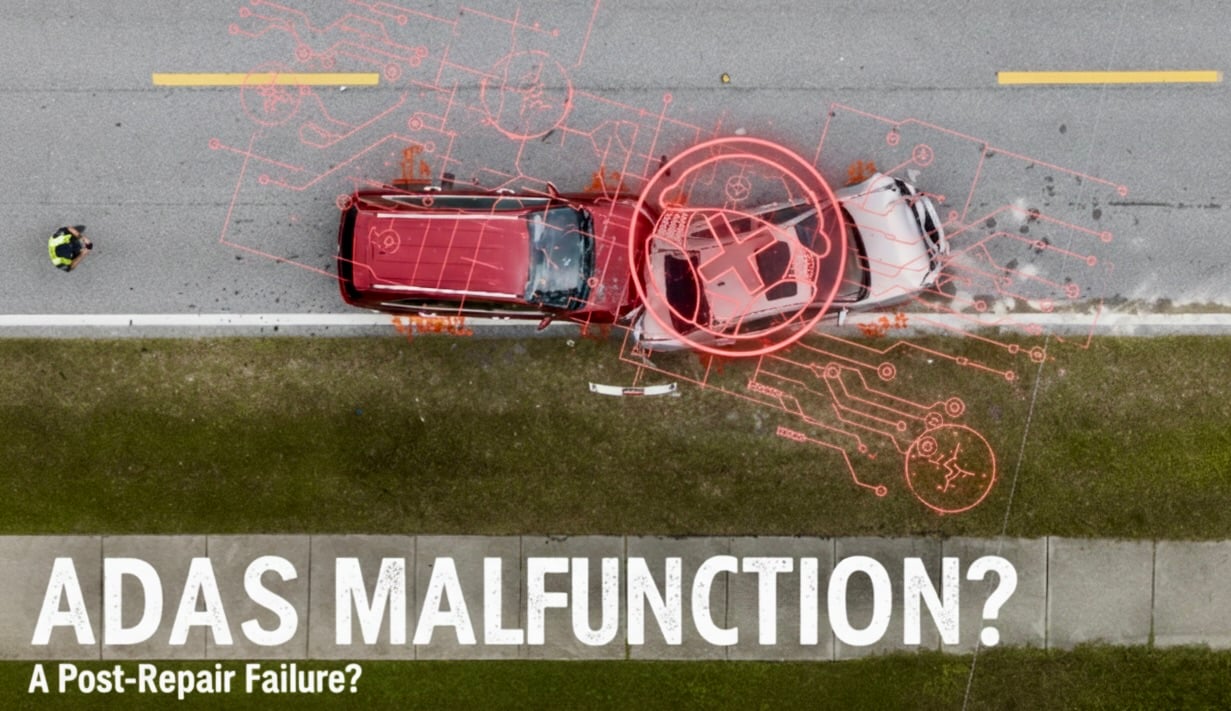
In one widely cited case reported by Repairer Driven News, the risks associated with missed ADAS calibration became very real. A Nissan vehicle was involved in a relatively minor collision and repaired at an authorized repair facility. According to Nissan’s OEM repair procedures, the forward collision warning system required recalibration as part of that repair. However, the shop performing the work did not have the calibration equipment or training needed to complete the procedure.
After the vehicle was returned to service, it was later involved in a second accident. During that incident, the forward collision warning system did not function as expected. The case became a widely discussed example within the industry of how missed OEM-required calibrations can become central in liability discussions when safety systems are later questioned.
During litigation, it became clear that OEM documentation explicitly required calibration, the repair facility did not perform it, and the shop lacked both the tools and training necessary to comply. The case highlighted how a missed ADAS calibration, following what initially appeared to be a minor repair, can significantly increase exposure when safety systems are later scrutinized.
The “No Lights, No Codes” Misconception
One of the most common misunderstandings in collision repair is assuming that warning lights or diagnostic trouble codes are the only indicators that calibration is required. In reality, many OEM calibration requirements are procedural rather than fault-based. Calibration is required because of the repair performed, not because the vehicle detected a malfunction.
Industry experts have been increasingly vocal about the risk this misunderstanding creates. As ADAS-Elite explains in its article No Lights Doesn’t Mean No Liability, the absence of warning lights does not eliminate liability when required calibrations are skipped. Safety systems can still operate incorrectly without triggering a fault code or dashboard alert.
From a liability standpoint, “the dash looked fine” is not the same as “the system was verified.”
Where Liability Usually Lands and Why
While every situation is fact-specific, liability most often falls on the repair facility that returned the vehicle to service.
Collision repair shops are generally responsible for:
- Restoring the vehicle to a safe, OEM-compliant condition
- Following manufacturer repair and calibration procedures
- Verifying and documenting required work
Even when calibration is sublet, responsibility often remains with the shop that controlled the repair process. Courts and insurers tend to focus less on who physically performed the calibration and more on who ensured it was required, completed, and verified.
Documentation as a Risk-Reduction Tool
Documentation doesn’t just support payment, it protects your business. Strong documentation typically includes:
- Pre-repair and post-repair scans
- OEM procedures tied directly to the repair performed
- Calibration reports showing completion and results
- Clear records of dates, tools, and outcomes
When liability is questioned, documentation turns uncertainty into clarity. Without it, shops are often left explaining decisions after the fact.
Outsourcing Calibration Doesn’t Eliminate Responsibility
Subletting calibration can make sense operationally, but it does not automatically transfer responsibility.
If calibration is required as part of a repair you performed, you are still responsible for confirming it was necessary, completed correctly, and documented. Subletting without verification creates gaps, and gaps are where liability tends to live.
What This Means for Your Shop Going Forward
Now you know where liability usually falls when ADAS calibration is missed or done incorrectly, it falls on the repair shop.
Hopefully, you can use this information to better protect yourself and your shop going forward by reducing assumptions, working with a solid calibration partner, and leveraging clear, consistent documentation.
If you’re looking to reduce sublets, gain more control over your workflow, improve consistency, and grow your business with in-house ADAS calibration supported by the right equipment and hands-on training, that’s a conversation worth having.