Back in 2018, the federal mandate for backup cameras shifted the automotive landscape, making rear-facing cameras a standard fixture intended for driver convenience and safety.
Today, the scope of vehicle optical systems has expanded dramatically. Modern vehicles are equipped with a network of sophisticated cameras positioned everywhere from behind the central rearview mirror to the outer side mirrors. These systems work together to power Advanced Driver Assistance Systems (ADAS), enabling features like lane keep assist, automatic emergency braking, traffic sign recognition, surround-view monitoring, and dynamic navigation guidance.
These systems do not simply respond to what the camera passively records. They respond to what the software interprets from the optical feed. That interpretation depends entirely on precise optical geometry.
According to the IEEE P2020 Automotive System Image Quality Draft Standard, precise camera positioning, optical geometry, and image calibration are critical to the performance and reliability of automotive vision systems, where even small geometric inaccuracies can significantly impact overall system effectiveness.
If the vehicle’s calibration is inaccurate, the camera’s interpretation becomes flawed. What was designed as a safety system can quickly become a liability.
Modern ADAS cameras are also evolving rapidly. Earlier systems once relied upon GPS because single cameras often lacked the image quality, processing speed, and depth perception needed to accurately judge distance. Today, camera technology has improved significantly. Some manufacturers are now relying more heavily on optical systems to support functions that once depended almost entirely on radar.
Subaru’s EyeSight system is one example. Earlier versions used a stereo pair of forward-facing cameras to estimate distance similarly to how human eyes work. Later versions added a third wide-angle camera to improve pedestrian detection, cyclist recognition, and lane-centering capability.
As cameras continue improving, manufacturers are expanding their role in everything from traffic sign recognition to lane-centering systems and assisted driving features.
Need help finding the right ADAS frame? Use our free ADAS Equipment Advisor.
The Danger of a Single Degree: Narrow vs. Wide Fields of View
Understanding how different cameras view the road is the first step in understanding why precision matters.
Automotive cameras generally fall into two categories:
- Narrow-view cameras are designed for long-range precision, often seeing up to 1,000 feet down the road
- Wide-view cameras provide broader peripheral coverage but shorter range
Narrow-view cameras support features like adaptive cruise control and lane keep assist at highway speeds. Wide-view and fisheye cameras are commonly used for surround-view systems, backup cameras, cross-traffic monitoring, and low-speed obstacle detection.
The risk of misalignment becomes clear when you consider distance.
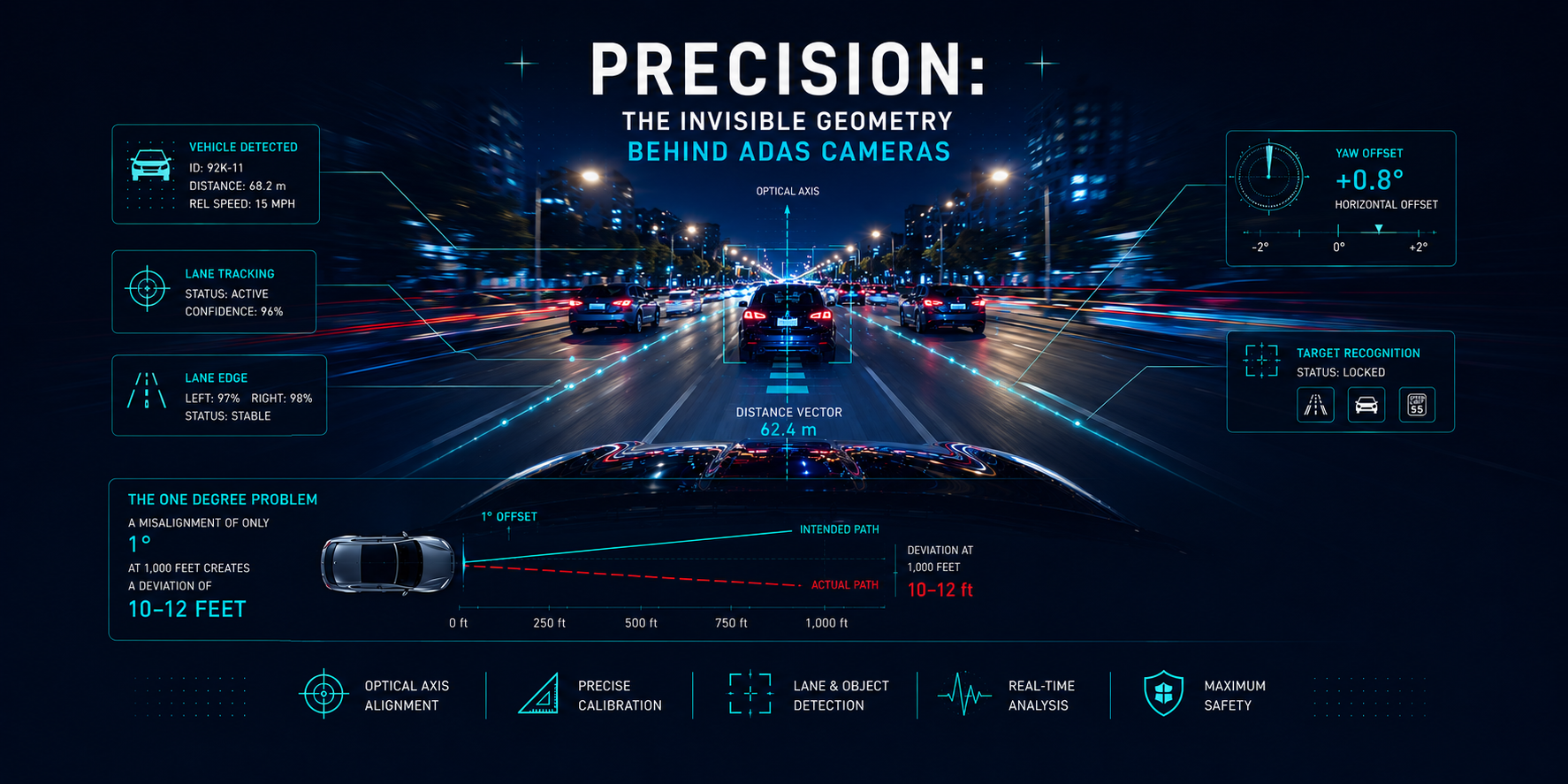
A forward-facing narrow-view camera misaligned by just one degree creates a massive downstream error. At 1,000 feet, that single degree translates into a deviation of roughly 10 to 12 feet — approximately the width of an entire traffic lane.
That means the vehicle could interpret a light pole, roadside object, or adjacent vehicle as being directly in its path, potentially triggering unnecessary emergency braking or improper steering intervention.
Modern lane departure and lane-centering systems rely heavily on this geometry. The windshield-mounted camera continuously analyzes painted lane markings and road edges to determine the vehicle’s position. Passive systems may simply provide warnings through dashboard alerts, steering wheel vibration, or audible tones. Active systems may physically steer the vehicle back into the lane. In some applications, simply activating a turn signal allows the vehicle to guide itself into the adjacent lane while monitoring surrounding traffic.
The precision behind these decisions depends entirely on what the camera believes it sees.
Why “Successful” Calibrations Fail on the Road
One of the most dangerous misconceptions in collision repair and auto glass is assuming that a scan tool showing a “successful” calibration means the vehicle is safe.
As discussed during Revv’s April 2026 webinar, Camera Calibration: Optical Geometry and OEM Nuances, windshield replacement and physical mounting issues can significantly affect calibration accuracy when cameras are mounted to or integrated with the glass itself.
According to Revv’s ADAS specialist Kevin Moring, one of the leading causes of calibration failures and customer comebacks is skipping critical prerequisites before calibration even begins.
A real-world example highlights the risk.
During windshield replacements on certain Dodge Ram models, the forward camera assembly also housed the radar sensor. A large national glass company experienced widespread issues because technicians skipped a required angle check and physical adjustment before performing the electronic calibration.
The result was severe.
Vehicles were physically drifting into adjacent lanes before the systems responded. Scan tools showed successful calibrations. No warning lights appeared. Yet the vehicle’s geometry was wrong.
The issue reportedly resulted in roughly 1,200 vehicles requiring corrective rework.
The root problem was not the scan tool. It was the failure to establish proper physical alignment first.
If a vehicle has a skewed thrust angle or is not tracking straight, the ADAS system cannot correctly interpret its position relative to the road. Calibrating on top of that condition creates a false positive.
A simple pre-check can prevent this:
- Test drive the vehicle
- Confirm the steering wheel is centered
- Verify the vehicle tracks straight
- Confirm suspension and alignment angles are within specification
Many OEMs reinforce this requirement. On some Volkswagen and Audi vehicles, even adjusting rear toe during alignment requires recalibration of multiple ADAS systems.
Another overlooked issue involves live calibration offset data. Many camera and radar systems store offset values that represent how the module was aligned during its last successful calibration. After a collision, windshield replacement, bracket movement, or parts replacement, those previously stored values may no longer be valid.
Even removing and reinstalling a camera without unplugging it can introduce physical changes significant enough to require recalibration.

Environmental Setup: The Invisible Saboteurs
Beyond the vehicle itself, the shop environment plays a major role in calibration success.
Lighting is one of the most common failure points. Many ADAS cameras do not operate in high-definition color. They often read targets in grayscale. Even small amounts of ambient light can interfere with target recognition.
Common issues include:
- Open bay doors
- Skylights
- Window reflections
- Light bouncing off nearby tools or equipment
All of these can disrupt the calibration process.
Fisheye camera systems add another layer of complexity.
For example, earlier Ford Copilot360-degree systems required massive target mats measuring roughly 35 feet long and 5.5 feet wide. These static calibrations demanded enormous controlled floor space and extremely careful setup.
Many newer systems have transitioned toward dynamic calibration procedures instead. During these calibrations, the vehicle enters a learning mode while driving. The camera gathers information from lane markings, steering input, vehicle speed sensors, and surrounding reference points to establish its calibration.
However, these procedures still require controlled driving behavior. Aggressive steering, inconsistent speeds, poor road markings, or unstable vehicle inputs can all compromise the process.
The Pitfalls of Measurement and the Metric Trap
Precision in measurement is non-negotiable.
Targets must be positioned exactly as specified by the OEM. Moving them slightly to force a calibration to pass introduces flawed reference data into the system.
One of the most common mistakes in North America is converting metric measurements into imperial units.
Most OEM procedures are written in millimeters and centimeters. Converting these values often introduces rounding errors or inaccurate placement.
For example, converting 11 millimeters into inches creates a measurement that is difficult to accurately reproduce using a standard tape measure.
Technicians may also misread procedures entirely, confusing values like 500 millimeters with 5 meters.
The solution is simple:
- Use metric measuring tools
- Use laser measurement systems whenever possible
- Avoid manual conversion calculations
Vehicle modifications also impact calibration.
Lift kits, altered ride heights, suspension repairs, and collision damage all change camera angles and optical geometry. Some OEMs now account for this directly. Certain Ford systems prompt technicians to input ride height before calibration, while Toyota provides dedicated procedures for lifted vehicles.
The Glass Factor and Bracket Vulnerabilities
Windshield replacement is one of the most common triggers for recalibration and one of the most common sources of problems.
OEM glass is often recommended or required because aftermarket glass may not maintain the necessary optical tolerances. Even a variation of one or two millimeters can alter the camera’s pitch angle enough to affect system accuracy.
A simple diagnostic technique can help identify distortion.
By wearing polarized sunglasses and viewing the windshield from a distance in direct sunlight, technicians can often identify subtle waves or optical inconsistencies in aftermarket glass that are otherwise invisible.
Mounting brackets must also be inspected carefully.
After a collision or windshield replacement:
- Brackets may be bent
- Locating pins may be damaged
- Cameras may not seat correctly
- Mounting clips may not fully engage
- Cameras may sit slightly loose inside the housing
Even slight mounting misalignment compromises the entire calibration.
In one real-world case, a technician troubleshooting a failed calibration discovered the camera had not been properly locked into its mounting bracket after windshield replacement. The scan tool could communicate with the camera normally, but the physical mounting position was incorrect enough to prevent accurate calibration.
Structural repairs can also trigger recalibration requirements. Some Honda vehicles, for example, require recalibration of forward-facing systems after rear structural repairs due to potential shifts in overall vehicle geometry.
The Final Step: The 5-Mile Road Test Verification
Calibration does not end when the scan tool confirms completion.
The final validation step is a real-world road test of at least five miles.
During this drive, technicians should actively evaluate system behavior:
- Engage lane keep assist
- Drift intentionally within a lane to test detection
- Observe warning alerts and steering intervention
- Test multiple sensitivity settings
- Verify smooth and predictable operation
Modern ADAS systems are constantly interpreting steering input, wheel speed, camera data, lane markings, and surrounding traffic conditions together. The calibration process only succeeds when all of those systems agree with real-world vehicle behavior.
Only when physical alignment, environmental control, precise measurement, and real-world performance all align can a shop confidently say the calibration was completed correctly.
Closing Thought
ADAS calibration is not a single step. It is a system of interconnected variables, each one influencing the next.
The scan tool result is only one piece of the puzzle. True accuracy depends on process discipline, environmental control, proper measurement, and respect for the invisible geometry driving everything the system sees.
As automotive cameras become more advanced and manufacturers rely increasingly on optical systems for assisted driving features, the importance of precision will only continue to grow.
If you are just getting started on your ADAS calibration journey, we're here to help! We can help you understand what equipment, training, space, and process your shop needs to calibrate collision-repaired vehicles with confidence.