
As more collision centers consider bringing ADAS calibration in-house, one question comes up early and often.
How much does an ADAS calibration system really cost?
Not in theory. Not best case. But realistically, with real equipment, real targets, and real shop conditions in mind.
In 2026, ADAS calibration pricing spans a wide range. That range exists for a reason. Different systems deliver very different levels of capability, coverage, integration, and efficiency. Understanding those differences is the key to understanding cost.
This article focuses directly on pricing and total investment. What shops can expect to pay, what drives those numbers, and how to interpret pricing ranges when evaluating ADAS equipment.
Need help finding the right ADAS frame? Use our free ADAS Equipment Advisor.
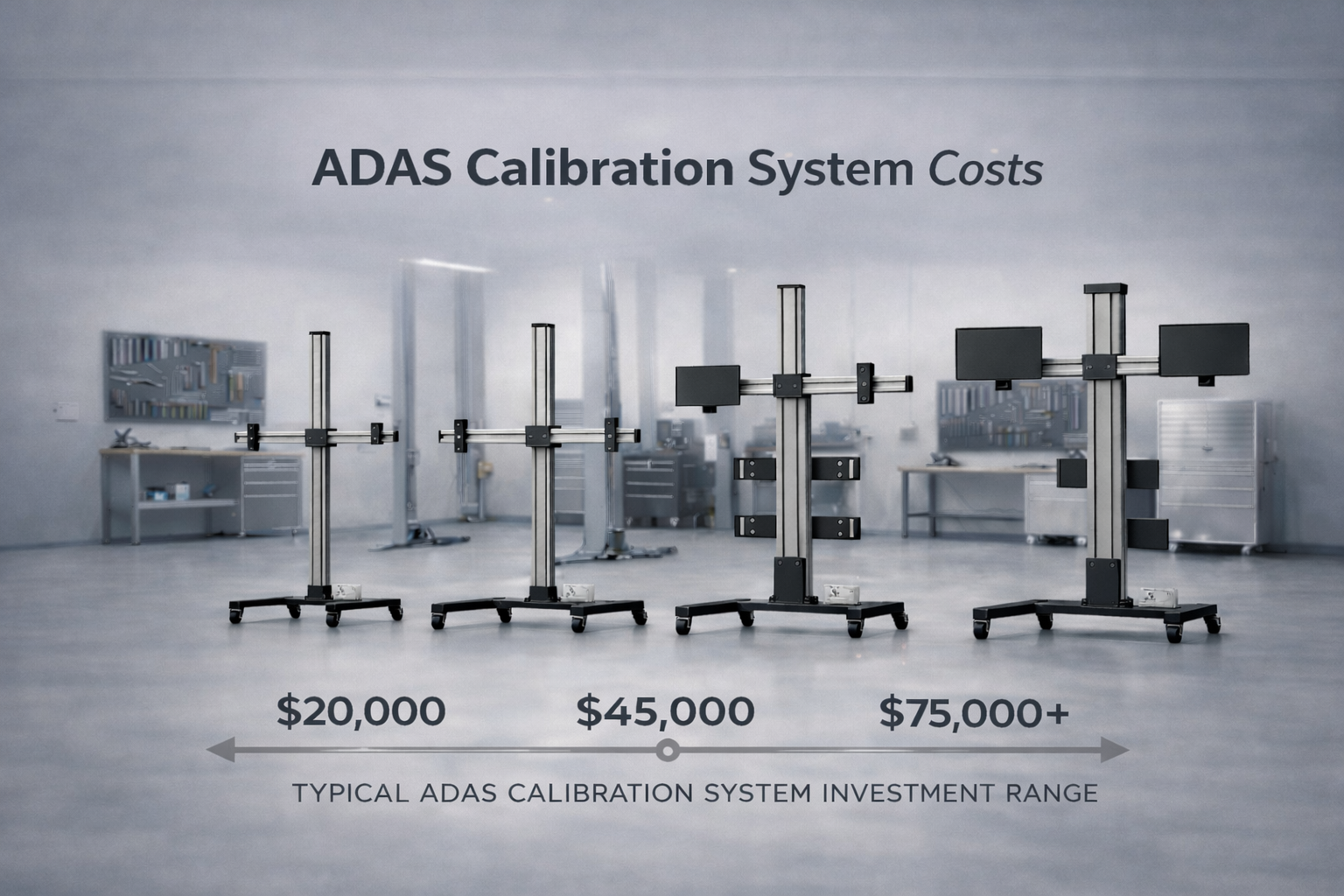
ADAS Calibration System Price Ranges in 2026
Based on current market pricing and common configurations, most ADAS calibration investments in 2026 fall into the following base ranges.
- Entry-level mobile or manual systems typically range from $20,000 to $30,000. These systems are often built around a manual frame with limited automation and a focused set of targets. They are commonly used by mobile glass operations or shops with lower calibration volume.
- Mid-tier modular systems generally range from $30,000 to $45,000. These systems add camera-based measurement, floor compensation, and broader OEM coverage. They are designed for shops that want to perform calibration consistently in-house without moving to a fully dedicated ADAS bay.
- Advanced integrated systems usually range from $40,000 to $55,000 when configured without a dedicated lift. These systems often support alignment integration, higher throughput, and reduced manual setup time.
- Fully automated or bay-integrated ADAS systems typically range from $60,000 to over $100,000, depending on configuration and level of integration. These systems are designed for higher-volume collision centers and shops looking to standardize calibration as a core operation with maximum integration, automation, and long-term scalability.
These ranges represent base system pricing before considering optional targets, facility preparation, or long-term operating costs.
Why ADAS Pricing Varies So Widely
ADAS calibration systems are often talked about as if they are interchangeable. In reality, they are not. The wide range in pricing reflects real differences in how these systems are engineered, supported, and used in the shop.
Several factors drive the variation in cost:
- Level of automation
- Breadth of vehicle and OEM coverage
- Integration between the calibration frame and the scan tool
- Depth of engineering and technical support
- Overall workflow efficiency in the shop
Another often overlooked factor is manufacturer DNA.
Some equipment providers come from a wheel alignment and undercar service background and later expanded into ADAS. Others were built around vehicle diagnostics and scan tool development. Because ADAS calibration depends heavily on vehicle communication, software execution, and precise interaction with the vehicle’s electronic systems, that origin can influence how the system is designed, integrated, and supported over time.
It is also important to understand that a lower entry price does not always mean a lower overall investment. In many cases, lower-priced systems shift cost into additional labor, slower workflows, added accessories, or future upgrades needed to keep up with evolving vehicle technology.
What Drives ADAS Price Differences?
The largest pricing differences between systems are driven by four primary factors.
1. Automation
Manual systems require technicians to measure, place, and verify targets by hand. More automated systems reduce setup time and variation by using cameras, software-guided placement, or robotic positioning.
Automation reduces variability. Variability affects repeatability. Repeatability affects rework and liability. That chain has cost implications.
2. OEM and Vehicle Coverage
Systems that support a wider range of vehicle makes and calibration procedures require more targets, deeper software development, and ongoing validation as new model years are released.
Broader coverage requires sustained engineering investment. Supporting new vehicle platforms, evolving camera systems, and emerging ADAS features is not a one-time development effort. It requires continuous updates. Systems backed by larger engineering teams typically reflect that ongoing investment in their pricing.
3. Workflow Integration
Not all systems integrate the calibration frame with the scan tool. In some configurations, the targeting frame and diagnostic device operate independently. In more integrated systems, the technician is guided from vehicle identification through target placement and calibration within a unified workflow.
That integration affects daily efficiency. When frame setup, vehicle communication, and calibration procedures operate within a single system, setup errors and wasted time can be reduced.
4. Engineering Depth and Support Infrastructure
ADAS is not static. Procedures evolve, vehicle software updates change requirements, and calibration tolerances tighten.
The depth of engineering behind a system directly impacts its long-term reliability and usability. Systems supported by active development teams and structured technical support may carry higher upfront pricing, but they are designed to reduce disruption, support evolving OEM requirements, and protect long-term operational performance.
Understanding the engineering investment behind a platform helps explain why two options with similar upfront prices can deliver very different long-term value.

What Is Typically Included at Each Price Level
At the lower end of the pricing range, systems typically include a frame, a limited set of physical targets, and basic measurement tools. Tablets and advanced software features may be optional or sold separately.
Mid-tier systems usually include a more complete target set, a dedicated calibration tablet, and software designed to guide target placement and verification. By providing clearer positioning guidance and structured workflow steps, these systems help reduce technician variability and setup errors. They often include onboarding or initial setup assistance.
Higher-priced systems typically include expanded target coverage, deeper software integration, and tools designed to reduce technician setup time. These systems often provide more precise measurement processes and validation steps, supporting more accurate calibrations and improved repeatability. In some cases, digital or screen-based targets reduce the need for additional physical target purchases over time.
Pricing differences are not just about what is included on day one. They also reflect how the system is designed to improve accuracy, reduce setup risk, and scale with the shop over time.
Additional Costs That Affect Total Investment
Beyond base system pricing, most shops should expect additional costs that affect total investment.
- Additional physical targets are common as shops expand OEM coverage. Depending on vehicle mix, this can add several thousand dollars over time. (Range $95 - $500 per target)
- Software subscriptions are recurring annual costs. (Range $1,295 - $1,695) These subscriptions support vehicle updates, calibration procedures, and compatibility with new models.
- Training carries cost even when included with equipment. Time spent learning, ramping up, and refining workflow should be accounted for in any realistic evaluation. (Range $1,295 - $2,500)
- Facility preparation may also be required. Floor condition, lighting, and space allocation can introduce one-time costs that vary by shop.
The full cost picture includes both hardware and operational readiness.
How Labor and Downtime Affect the Real Cost
Two systems with similar purchase prices can have very different operating costs.
Manual systems often require more setup time per calibration. That time comes directly out of technician productivity.
More automated systems may carry a higher upfront price but reduce setup time and variability. Over weeks and months, that can lower cost per calibration.
One experienced shop owner frames it this way: if a technician who typically produces $300 to $400 per billable hour loses a full day to setup, unsupported procedures, or a lack of guidance, that lost productivity can amount to several thousand dollars. In higher-volume operations, a single lost day can exceed the price difference between systems.
The purchase price is visible. The cost of inefficiency is less obvious, but it compounds quickly.
When evaluating pricing, shops should consider not just what they pay to acquire the system, but what it costs to use it every day.
Capital Planning and Financing for ADAS Systems
ADAS calibration equipment is typically treated as a capital purchase. Many shops spread cost over time through financing rather than paying the full amount upfront.
In some cases, IRS Section 179 may allow qualifying equipment to be expensed in the year it is placed into service. Tax treatment depends on individual circumstances and should be reviewed with a CPA.
Financing and tax planning affect cash flow, but they do not change the underlying economics of the investment. The system still needs to justify its cost through productive use.
For shops evaluating how to structure the investment, financing strategy can significantly affect timing and return. Spreading cost over time often allows calibration revenue to offset equipment payments, improving cash flow and accelerating ROI. We explore this in more detail in our article, Starting ADAS Calibration: Smart Financing Strategies for Body Shops, which outlines practical approaches shops use to align capital investment with operational return.
What Shops Are Really Paying For
At its core, ADAS calibration pricing reflects more than hardware. Shops are paying for:
- Capability
- Coverage
- Repeatability
- Integration
- Engineering continuity
- Reduced variability
- Operational confidence
Systems that cost more upfront often reduce uncertainty, rework, and downtime over the life of the equipment.
A productive way to compare options is not simply by total number, but by the difference between systems and what that incremental investment delivers. The question becomes: what does the additional investment buy in terms of automation, coverage, and efficiency?
The goal is to purchase the system that aligns with your volume, vehicle mix, technician skill set, and long-term strategy.
Making the Right ADAS Calibration Investment for Your Shop
ADAS calibration systems in 2026 range from roughly $20,000 to $75,000 or more. That range reflects real differences in capability, coverage, integration, and long-term operational cost.
The right investment is the one that aligns with how your shop operates today and where your calibration volume is heading next. Understanding pricing clearly is the first step toward making a disciplined, confident decision.
The real value of a system is found in its ability to generate a return on your shop's floor. To help you evaluate this, we provide an ADAS ROI Calculator that factors in your specific weekly number of calibrations, alignment checks, sublet prices, and equipment costs. This allows you to see the point where a system moves from a capital expense to a primary revenue driver for your shop.
If you would like to discuss your specific vehicle mix, calibration volume, and growth plans, why not schedule a conversation with one of our ADAS specialists? We can walk through pricing ranges, system differences, and what makes the most operational sense for your shop.
Topics:
