The most dangerous ADAS failure isn't a faulty sensor, it's the calibration that never happened because nobody knew it was required. Modern collision repair is complex, but one of the biggest ADAS challenges often happens before a technician ever begins a calibration. A shop may have trained technicians, the right equipment, and a vehicle with no obvious warning lights yet still overlook an OEM-required calibration or safety procedure.
Why?
Because ADAS requirements are often triggered by the repair work being performed, not simply by a warning light, diagnostic trouble code, or scan result.
That creates a hidden workflow problem.
If a required calibration is not identified during estimating or repair planning, it may not surface until much later in the repair. By then, the shop could be dealing with another supplement, an insurance question, a scheduling delay, or a vehicle that needs additional work before it can safely leave the facility.
The challenge is not simply performing calibrations correctly.
It is identifying everything the vehicle requires early enough to plan, document, perform, and get paid for the work.
That is where ADAS workflow tools such as Revv can help.
Where the Hidden Gaps in ADAS Workflows Begin
ADAS calibration decisions can be surprisingly easy to miss.
One common misconception is that a warning light or diagnostic trouble code will always tell a shop when calibration is required. But OEM procedures may require a calibration, inspection, reset, scan, or other operation because of the work performed on the vehicle — even when the dashboard provides no obvious warning.
Consider something as routine as removing or replacing a bumper.
Depending on the vehicle, that repair may affect radar, sonar, parking sensors, cameras, or other systems. The calibration requirement exists because of the repair procedure and the manufacturer's instructions, not necessarily because the vehicle detected a fault.
That means scans remain important, but they do not answer every question.
The shop still needs to determine what procedures the manufacturer requires based on the specific vehicle and the specific repair.
Doing that manually can create another problem.
A collision estimate can contain dozens — sometimes hundreds — of individual operations. Researching those operations one at a time against current OEM procedures takes time and introduces another opportunity for something to be overlooked.
Need help finding the right ADAS frame? Use our free ADAS Equipment Advisor.
Complexity Outpaces Memory
As vehicle complexity grows, relying on memory or disconnected manual processes becomes increasingly difficult. Revv describes connected workflows as a way to reduce duplicate work, manual entry, communication gaps, and late-stage delays by getting information into the repair process earlier.
What Does Revv Do?
At its simplest, Revv provides another layer of review between the repair estimate and the ADAS work that may ultimately be required.
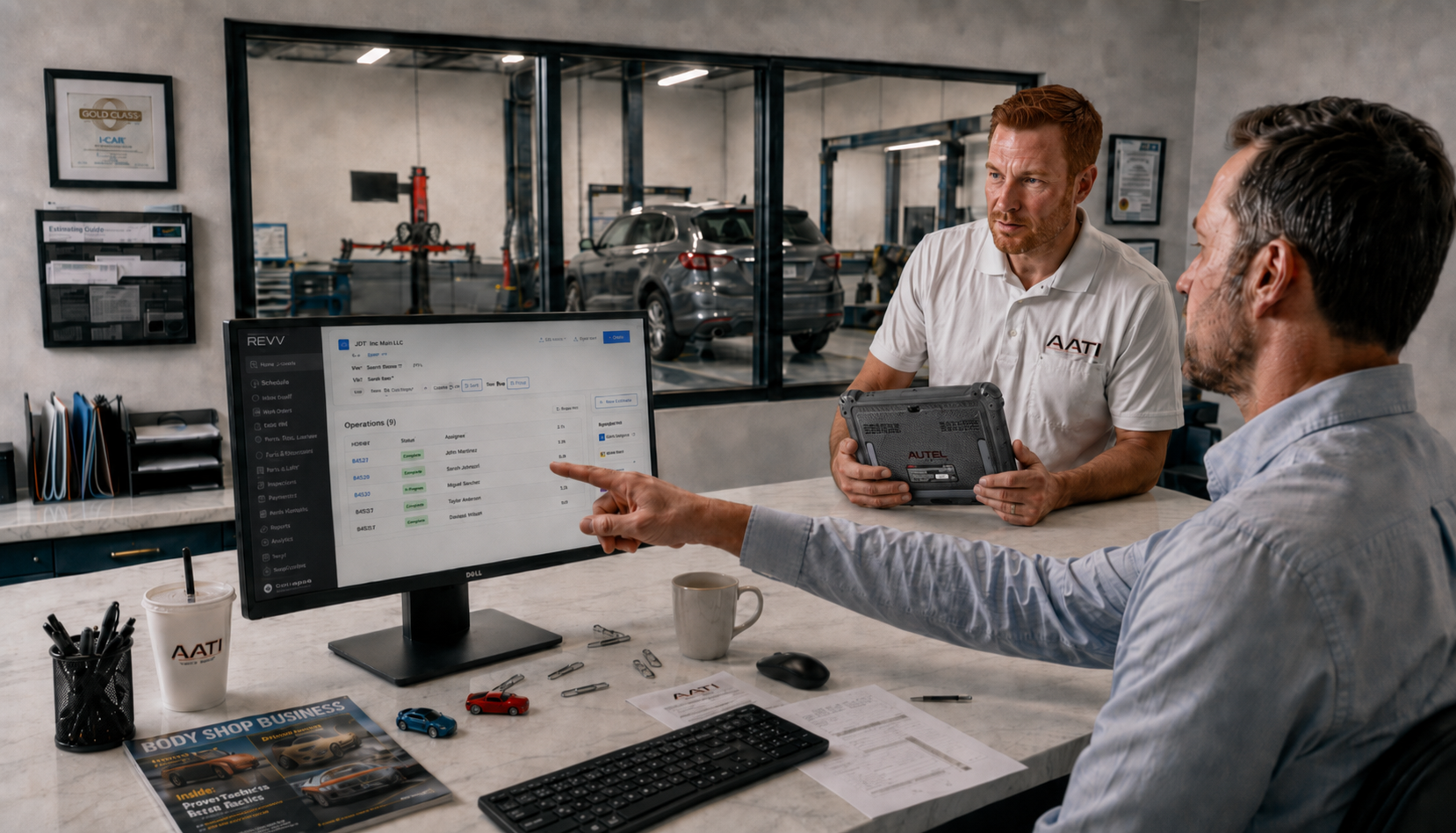
Instead of asking someone in the shop to manually research the estimate line by line, the repair estimate can be run through Revv.
The software evaluates the vehicle and repair information and identifies ADAS calibrations and related safety procedures that may be required based on OEM information.
- Revv identifies the 'What' and 'Why': It scans the estimate to flag mandatory OEM procedures and safety triggers.
- The Technician handles the 'How': The physical setup, environment control, and execution of the OEM procedure remain in the expert hands of the tech.
In a typical workflow, the shop can take the estimate it already has, upload it into Revv, and generate a report showing applicable ADAS and safety operations. According to the real-world workflow shared with us, that report can be generated very quickly and used early in the repair planning process rather than waiting until the vehicle reaches the end of production.
That gives the shop an opportunity to make ADAS part of the repair plan from the beginning.
See How the Revv Workflow Works
Sometimes the easiest way to understand a workflow tool is simply to see it in action.
In the video below, we walk through how a repair estimate can be brought into Revv and turned into a clearer picture of the ADAS calibrations and safety procedures associated with the repair.
The important part of the process isn't simply that another report gets created.
It is what the shop learns from that report — and when it learns it.
From a Repair Estimate to an ADAS Repair Plan
A Revv report can provide much more context than a simple statement that a calibration may be required.
The sample report provided for this article is based on a 2021 Subaru Ascent Touring. Subaru calls its ADAS EyeSight® Driver Assist Technology. Revv identified two ADAS operations and two safety operations associated with the vehicle and repair.
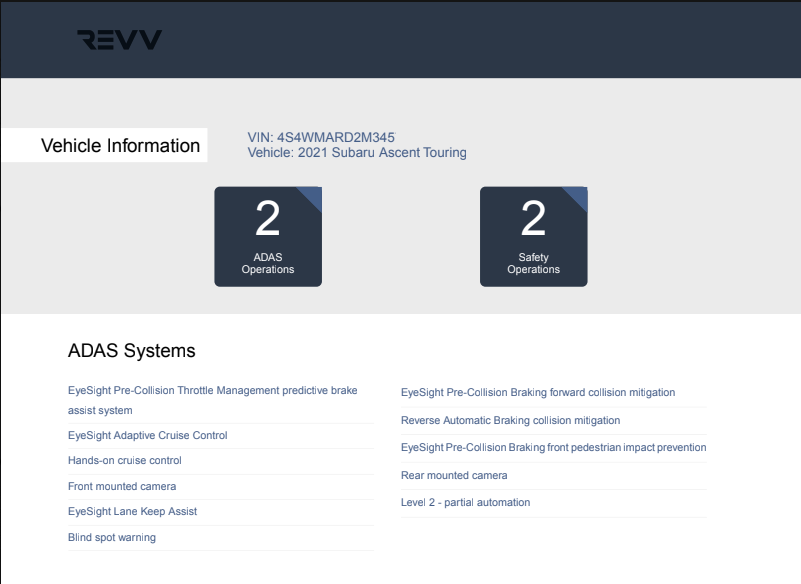
One involved the rear sonar sensor.
The report identifies the procedure type, component location, repair triggers, tools required, and the vehicle functions associated with that sensor. It also shows that operations involving the parking sensor or rear bumper can trigger additional requirements.
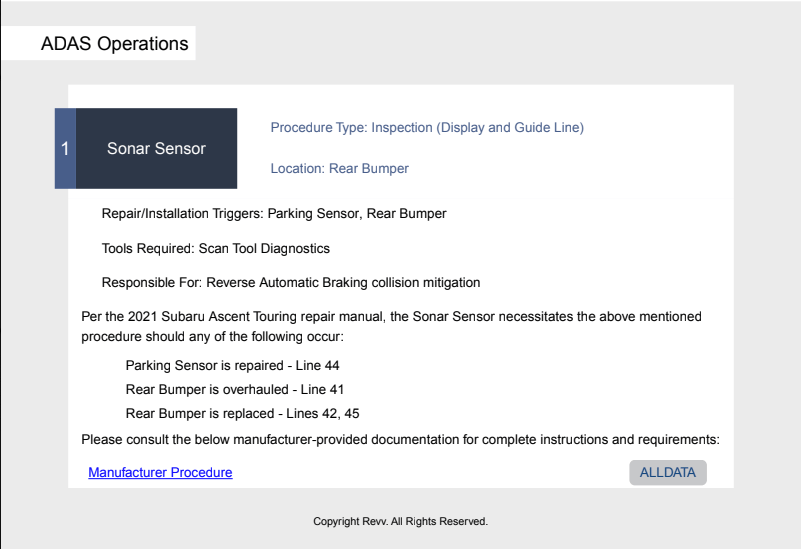
The same report identifies a stereo-camera calibration associated with collision damage and provides information about the type of calibration and tools or conditions that may be required.
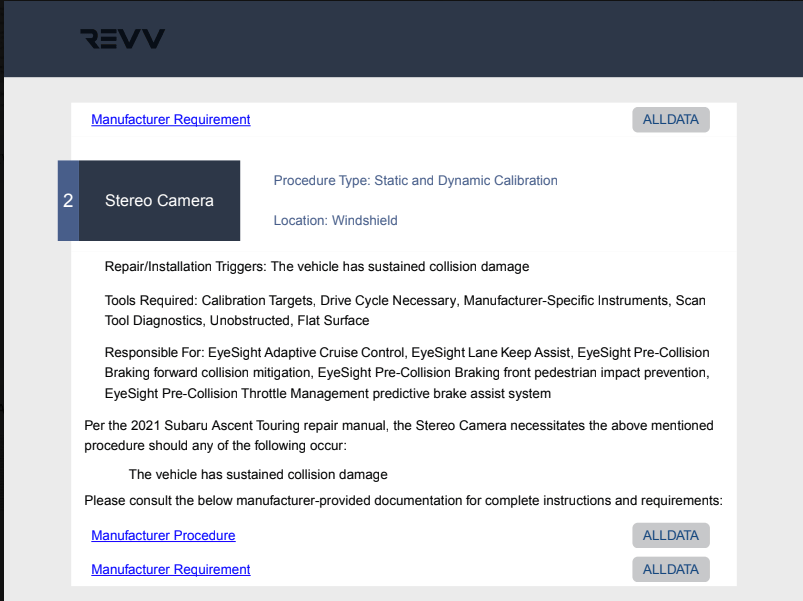
For the shop, that turns a vague question, “Does this vehicle need calibration?" into several much more useful questions:
- What ADAS systems are involved?
- What repair operation triggered the requirement?
- What procedure is required?
- What equipment may be necessary?
- What manufacturer information supports the procedure?
Those are questions that can help the estimator, technician, manager, and calibration provider work from the same basic understanding of the repair.
Connecting the Requirement Back to OEM Information
Identifying a procedure is only part of the job.
The shop also needs to understand why the procedure is required.
The sample Revv report includes links to manufacturer procedure and requirement information, including ALLDATA references for the Subaru example.
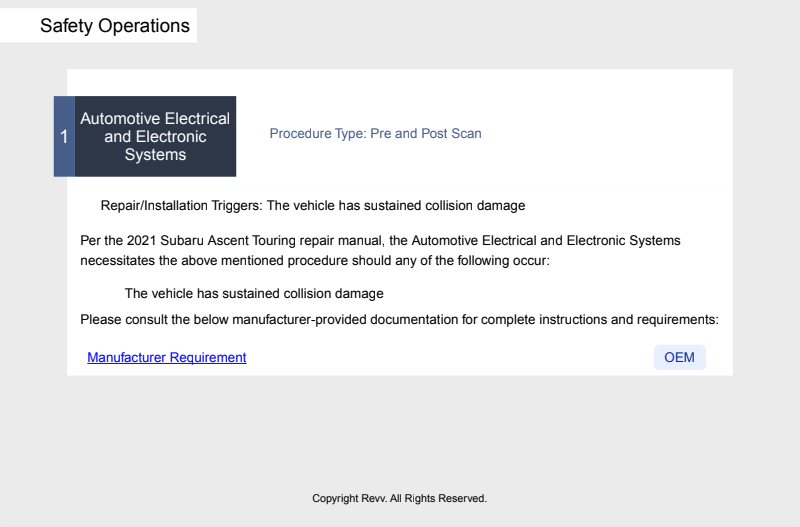
That supporting information can make a significant difference in how the repair is planned and documented.
Instead of relying on: “We believe this calibration needs to be performed.” the conversation becomes: “This repair operation triggered this procedure, and here is the manufacturer information supporting that requirement.”
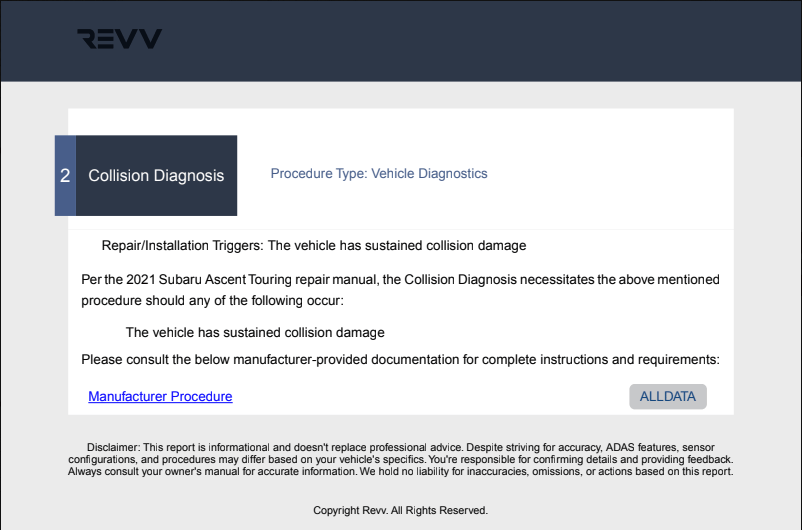
That distinction matters internally, and it can matter even more when a shop needs to explain the work to an insurer.
It is also important to remember that workflow software does not replace OEM repair information. The Revv sample report itself directs users to consult the manufacturer-provided documentation for complete instructions and requirements.
The software helps surface the need. The OEM procedure still governs how the work should be completed.
Identify the Work Earlier, Not at the End of the Repair
One of the biggest potential advantages of using Revv has less to do with the calibration itself and more to do with timing.
ADAS requirements are much easier to manage when they are identified during estimating or blueprinting.
Moving ADAS identification earlier allows the shop to start answering important operational questions before that happens.
For example:
- Will the calibration be performed in-house or sublet?
- Does the shop have the correct targets, tools, and space?
- When should the calibration be scheduled?
- Are additional scans, resets, inspections, or programming procedures required?
- What needs to be included in the repair plan?
- What documentation may be needed for the insurer?
That changes ADAS from something the shop reacts to near the end of the repair into something that can be managed throughout the repair.
For a busy collision center, that can be a meaningful difference.
Better Documentation Can Support Better Insurance Conversations
ADAS work also creates an administrative challenge.
It is one thing to tell an insurer that a calibration is necessary.
It is another to show what triggered the calibration, what the manufacturer requires, and what the associated work will involve.
That is another area where the workflow becomes valuable.
The sample Revv report does not simply identify the procedures. It ultimately organizes the identified ADAS and safety operations into projected pricing as well. In the Subaru example, the final page lists each operation individually and provides a projected total for the work identified.
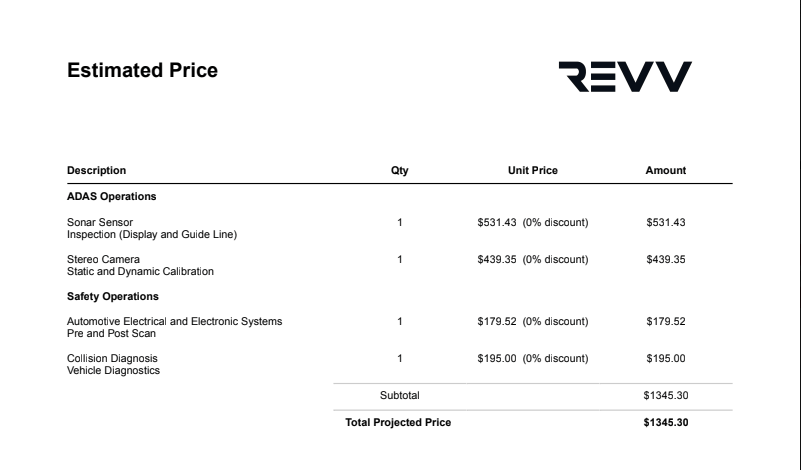
That can allow the shop to address calibration requirements earlier with the carrier rather than discovering them after the repair is nearly complete.
Our own real-world experience with the workflow reinforces that point: the report can become part of the repair documentation early enough to help support pre-approval discussions and provide the shop with manufacturer information if questions arise later. Revv's own workflow guidance similarly emphasizes moving documentation upstream so that expectations with insurers, customers, and technicians are established earlier in the repair.
The goal isn't to create more paperwork.
It's to make the paperwork the shop already needs more complete and easier to defend.

The Benefits Depend on How Your Shop Handles Calibration
Not every collision facility approaches ADAS the same way.
Some shops perform a significant amount of calibration work in-house. Others use mobile calibration specialists, dealerships, or other sublet providers. Many shops operate somewhere in between.
The same workflow tool can provide different benefits depending on the model.
For Collision Repair Shops
For the body shop, Revv can primarily provide visibility, planning, and documentation.
Identifying requirements earlier helps the shop understand what must happen before the vehicle is returned to the customer.
If the work will be sublet, the shop can coordinate it earlier.
If the work will be completed in-house, the shop can plan equipment, technician time, bay availability, and necessary procedures in advance.
Either way, the shop gains another systematic checkpoint rather than depending entirely on memory or discovering requirements late in the repair.
For Calibration Providers
For mobile and dedicated calibration businesses, the challenge often shifts toward consistency and scale.
A provider working with multiple collision centers may be receiving estimates, repair information, scans, OEM research, scheduling details, and billing information from several different sources.
Connected workflow tools can help organize that information and reduce the back-and-forth required to determine what work is necessary.
The Revv workflow model is designed around connecting estimating, identification, OEM procedure information, documentation, invoicing, and claims-related processes rather than treating each as an isolated task.
For higher-volume providers, reducing those disconnected handoffs can become increasingly important as the business grows.
Revv Doesn't Replace the Technician
There is an important boundary to understand with any ADAS workflow platform.
-
Software does not replace technician judgment.
-
It does not replace proper calibration equipment.
-
And it certainly does not replace the OEM procedure.
Instead, a tool like Revv helps strengthen the process around the technician.
It helps the shop identify the procedures that should be investigated, provides supporting information, and creates a more consistent way to document what the repair requires.
The technician still needs to verify the manufacturer's instructions, prepare the vehicle correctly, establish the proper calibration environment, use the correct equipment, perform the procedure, and confirm successful completion.
That distinction is important because successful ADAS calibration depends on both sides of the equation: good information and good execution.
Having sophisticated calibration equipment won't help if the shop never identifies that the procedure is required.
Likewise, identifying the procedure does not ensure a successful calibration unless it is performed correctly.
The strongest workflow connects the two.
A Small Workflow Change Can Close a Large Gap
ADAS calibration is becoming a larger part of everyday collision repair.
That doesn't necessarily mean every improvement needs to make the repair process more complicated.
Sometimes the biggest improvement comes from putting better information into the process earlier.
Rather than waiting for a dashboard light, depending on memory, or discovering an overlooked calibration after the vehicle is nearly complete, workflow tools such as Revv give shops another way to evaluate repair activity against ADAS and safety requirements during the planning process.
That can help a shop answer three important questions before the vehicle reaches the end of the repair:
- What needs to be done?
- Why does it need to be done?
- How are we going to document it?
When those questions are answered early, the calibration itself becomes easier to plan, easier to communicate, and easier to make part of a repeatable repair process.
And for collision centers trying to manage increasingly complex vehicles without adding unnecessary friction, that may be one of the most valuable improvements of all.
Now you know one way to solve hidden gaps in your calibration workflow. While there are a couple of solutions to choose from, we use and recommend Revv. It is easy, straightforward, and a go-to tool for us.
Don't leave your ADAS workflow to chance. Reach out to an AATI ADAS Expert today to turn your 'late-stage scrambles' into a predictable, profitable, and documented repair process.
Topics:
