
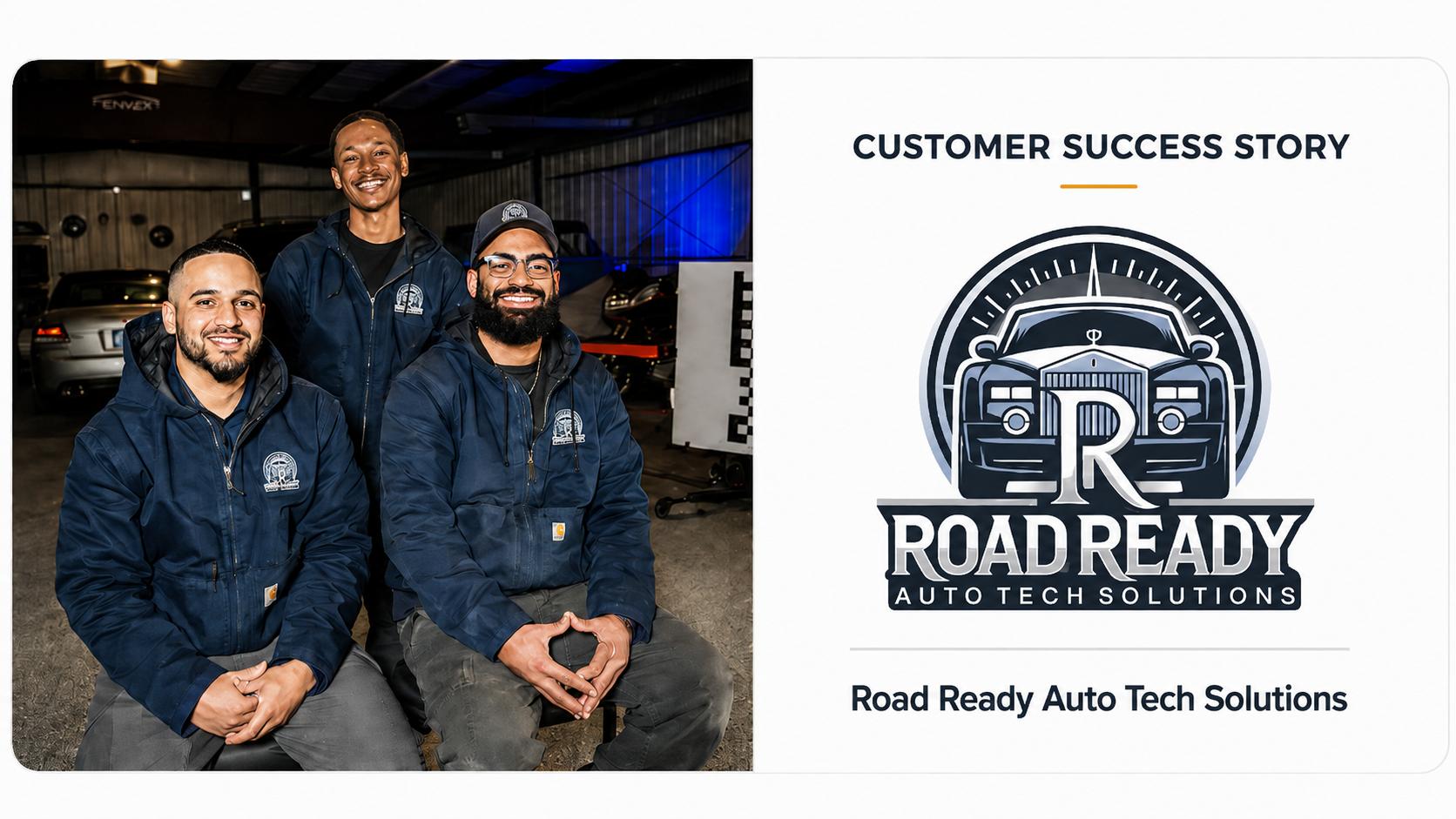
When Tyler Lu and his partners Kevin Nuñez and Dennis Mezquita launched Road Ready in the fall of 2024, they weren’t guessing where automotive repair was headed. They were responding to what was already happening.
The trio shares a lifelong bond, having grown up and attended school together. Tyler had early exposure to the automotive industry through his family. His uncle worked on vehicles and programmed key fobs, giving him an early look at how rapidly vehicle technology was evolving. It was a sign of where the industry was headed.
As advanced driver assistance systems (ADAS) have become standard equipment on modern vehicles, one thing is clear: these systems are here to stay, and it was no longer optional for body shops to offer ADAS calibration. Following collision repairs involving vehicle structure, sensor mounts, or alignment, calibration is essential to return systems to manufacturer specifications and guarantee a safe repair.
The team recognized that shops needed help keeping up with the growing demand for proper ADAS calibration. Road Ready was conceived as a focused mobile solution to support that shift. Operating out of a Ford Transit van equipped with an Autel MaxiSYS IA700, they bring professional calibration services directly to clients.
“I realized where the industry was going, where it’s all coming off a computer,” Tyler recalls, “and I had to figure something out, quick.”
“Whenever a car wouldn’t cooperate,” Mezquita remarked, “Tyler was like, ‘See? This is why we need to get into ADAS. We can handle this, we can fix this if we have the right tools.’”
Choosing the Right Equipment
For a mobile calibration business, equipment selection is foundational. Portability, structural stability, repeatable setup, and professional presentation all matter.
Road Ready worked with Applied Automotive Technology to evaluate options and select the right system for their business model. They ultimately purchased the Autel IA700 from Applied, choosing a commercial-grade frame system capable of accurate optical target positioning and repeatable setup across different shop environments.
Autel’s reputation also played a role. As a leading developer and manufacturer of professional diagnostic and calibration equipment, the brand carries weight inside collision shops.
“It’s a very great, sturdy system all around,” Nuñez notes. “The whole shop will just stop. You see that red frame come out, and it’s like we have the red carpet rolled out for us.”
The IA700 is not an entry-level investment. A fully configured package today can cost approximately $41,000 at MSRP. When Road Ready purchased the system, they knew they would have to build the business from the ground up.
“It’s scary at first,” Tyler admitted. “We were doing the keys already, so we had somewhat of a customer base, but it was a big chunk of change, so we had to go out and build more.”
“This was something we had to pursue,” emphasized Mezquita. “Why only stop with keys and certain programming? Why not just be a one-stop shop?”
They believed the demand was there. It was up to them to capture it.
Need help finding the right ADAS frame? Use our free ADAS Equipment Advisor.
Training and Support
For Road Ready, the difference-maker was not just the hardware. It was the support and training behind it.
Before launching, the team spent two and a half days at Applied’s Calibration Studio participating in structured, hands-on training. The Applied team used real-world collision-repaired vehicles throughout the sessions, working through system setup, evaluation of the bay area, documentation standards, workflow execution, and troubleshooting procedures on real collision-repaired vehicles.
“It’s intimidating,” Tyler explains. “I realized I had a little bit to learn. Gary and Rob walked us through the whole thing.”
That immersive training helped eliminate uncertainty. The team learned how to evaluate shop conditions, control setup variables, and resolve issues when calibrations did not complete smoothly.
Equally important was ongoing access to technical support. When Road Ready encountered challenging vehicles or unusual conditions in the field, experienced professionals were available to assist.
Tyler highlights the support: “Any time we had any type of problem, it’s ‘Hey, Rob,’ and he’ll give us advice through the phone. Rob’s our mentor on this, definitely.”
For a new mobile operation, that combination of proper equipment selection, structured education, and real-time support reduced risk and accelerated capability.
See the Road Ready Team’s Experience
In the video below, the Road Ready team shares how the right equipment, hands-on training, and continued support helped them get their mobile ADAS calibration business up and running.
Building the Business
Road Ready began operations shortly after acquiring their IA700. From day one, they took a direct, relationship-driven approach. They visited local collision centers, introduced themselves, and positioned their service clearly.
“Sometimes you have to show your face 2 or 3 times,” Tyler points out, “but once you get a job in from that shop, you do a good job, they’re gonna call you back.”
Their mission is straightforward: help body shops complete repairs properly. They offer responsive turnaround times, pickup and delivery, complete calibration documentation reports, and volume-based pricing.
“Anything with a computer and a car,” Tyler jokes, “we’re your tech nerds.”
Importantly, that emphasis on safety remains central to their identity. Proper calibration protects the vehicle owner, their families, and everyone else on the road. ADAS systems are designed to prevent collisions and reduce injury. If they are not calibrated accurately after repairs, those systems may not function as intended.
“I’m also a father, so I understand safety to a whole other level,” Nuñez shared. “A life is a life, at the end of the day, and ADAS reduces a lot of hazardous situations from happening.”
Today, Road Ready performs approximately 30 to 35 calibrations per month. Single-system calibrations can range from $100 to $500 depending on the vehicle and procedure, and many vehicles require multiple calibrations per repair.
At that volume, calibration provides a consistent revenue stream tied directly to everyday collision repairs. For a three-person mobile operation, that steady workflow supports equipment investment, operating costs, and continued expansion.
They have demonstrated that when professional-grade equipment is paired with proper training, disciplined execution, and strong shop relationships, a mobile calibration model can scale.
Looking Ahead
As vehicle technology advances, the need for accurate setup, documentation, and verification will only increase. Industry estimates place the North American ADAS calibration market at approximately $1.2 billion in 2024, with continued growth expected as more vehicles incorporate advanced safety systems.
Road Ready is preparing for its next phase. The team is discussing adding a second calibration frame to increase capacity and expand service coverage across Massachusetts.
“We want the business to grow,” Mezquita says. “We want to add another frame, add more workers to our team, and consistently grow year by year.”
For entrepreneurs watching the same shift in automotive collision repair, the lesson is clear: invest in the right tools, build capability, focus on safety, and execute with professionalism. The opportunity is already here.
“This is an industry with money to be made,” Tyler concludes. “There’s obviously enough cars for everybody to work on. Keep going, and you’ll see the network and the profits grow pretty quickly.”
Topics:
