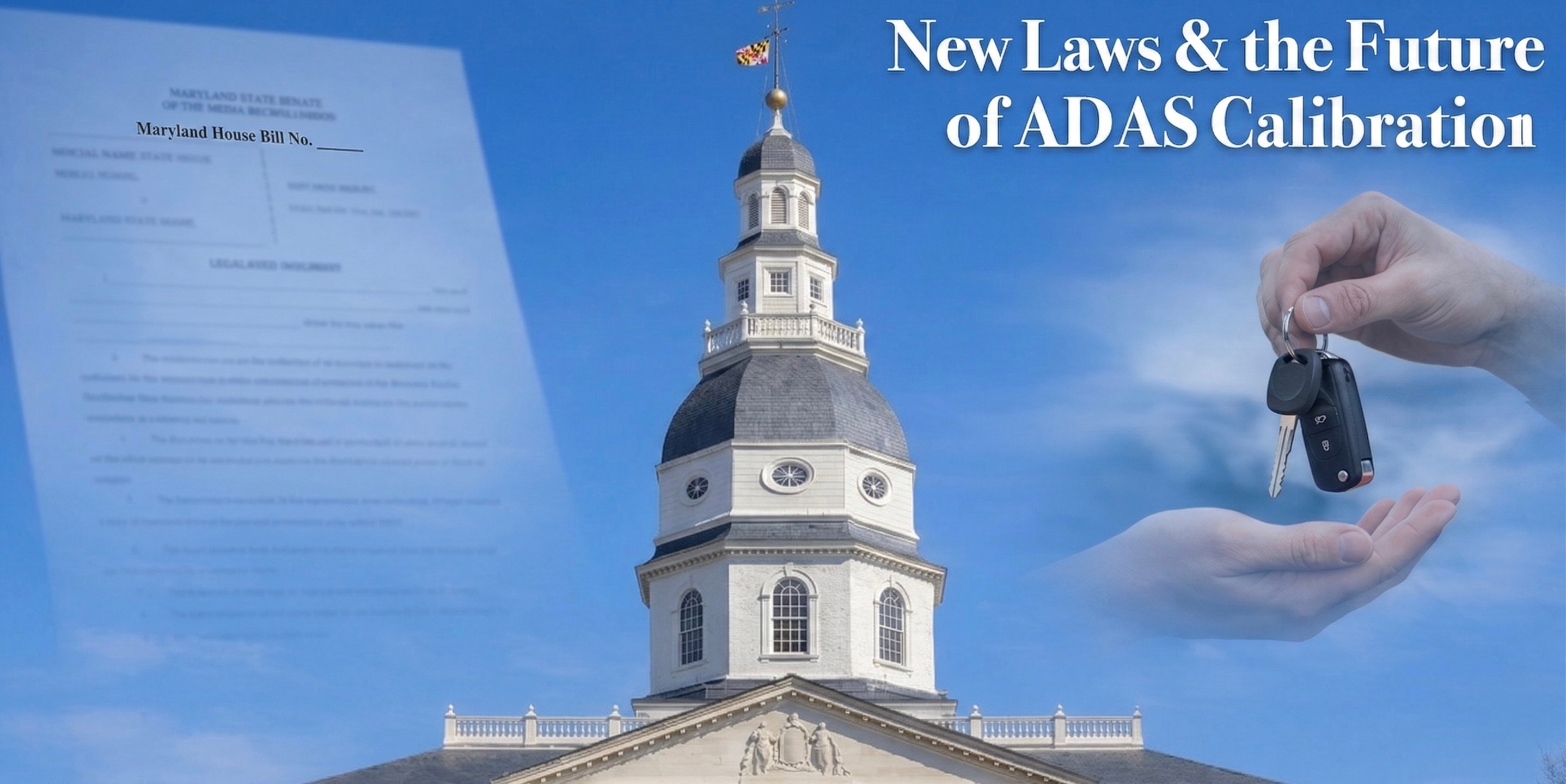
Laws already on the books, and more currently being proposed, are beginning to reshape how ADAS calibration is performed, documented, and paid for across the country.
In multiple states, and increasingly at the federal level, new legislation is taking shape that will directly impact how this work is done and reimbursed. The question is no longer if this will affect your shop, but how prepared you are when it does.
According to a recent industry survey, nearly 61% of vehicles arriving for collision repair require some form of ADAS calibration, yet industry data suggests that nearly half of all U.S. shops miss required post-repair calibrations. When a single ADAS-related lawsuit or settlement can cost a shop anywhere from $200,000 to $1 million or more, skipping these safety steps is a risk you simply cannot afford to take.
At Applied Automotive Technology, we perform calibrations every day, and we work closely with shops that are both performing calibrations in-house and subletting them.
We understand the real-world needs, concerns, and pressures shops are dealing with. This article is intended to help you better understand the changing legislative landscape and what it could mean for your business.
Need help finding the right ADAS frame? Use our free ADAS Equipment Advisor.
Why Now: Maryland’s SB0789 Changes the Game
Recent legislative activity in Maryland is sending shockwaves through the automotive repair industry, signaling that strict state oversight of ADAS calibration is gaining momentum.
At the center of that momentum is Maryland Senate Bill SB0789, which is currently proposed legislation and has not yet been enacted into law. As with any bill, it must move through committee review, potential revisions, and full legislative approval before becoming enforceable.
If passed, SB0789 would establish rigorous professional standards and licensing requirements for individuals and businesses performing ADAS calibration services. Status and committee progress on the bill can be tracked here. The bill is widely viewed as an effort to eliminate the "gray area" of calibration by legally mandating that shops follow Original Equipment Manufacturer (OEM) specifications.
Here is exactly what Maryland’s proposed legislation outlines:
- Mandatory Licensing & Facility Standards:
Any person performing ADAS recalibration must be licensed by the Motor Vehicle Administration (MVA). Facilities must maintain a controlled environment and possess the specific tools and equipment that meet or exceed OEM specifications. - Strict Adherence to OEM Procedures:
It would be illegal to use methods or equipment that do not meet OEM specs, or to return a vehicle to a customer without calibrating the system according to the manufacturer's repair procedure. - Mandatory Post-Repair Scanning & Documentation:
Shops would be required to conduct post-repair scans to verify the systems are functioning properly and must keep detailed records of all scans and recalibrations. - Consumer Transparency:
Before any work begins, shops would be required to provide a written statement explaining the ADAS components impacted, the required recalibration, the estimated price, and the safety implications of skipping the work. A detailed post-repair statement would also be required.
But there is a massive silver lining for shop owners embedded in the proposal. SB0789 includes provisions that would prohibit insurance companies from denying coverage for any repair or recalibration recommended by the OEM.
Additionally, insurers would not be permitted to require repairs that conflict with OEM procedures, and estimates would need to include line items for pre- and post-repair diagnostic scanning, necessary recalibrations, and the cost of the tools and facility requirements needed to perform the work properly.
If enacted, this framework would effectively require insurers to pay for doing the job correctly. However, the proposal also outlines meaningful enforcement mechanisms. Shops that fail to comply could face civil fines up to $5,000 per violation, along with the potential suspension or revocation of their facility license.
The National Shift: What Other States Are Doing
Maryland isn’t acting in isolation. Across the country, state legislatures are increasingly turning voluntary manufacturer guidance into enforceable rules—signaling that ADAS regulation is quickly becoming the norm.
Florida's Crackdown on AOBs and Inducements
Florida recently overhauled its auto glass and repair laws with SB 1002 (and its companion HB 541). Historically, Florida saw a massive spike in auto glass lawsuits jumping from 478 in 2011 to over 33,000 in 2022 largely driven by shops using Assignment of Benefits (AOB) agreements and offering cash or gift cards to customers to file insurance claims.
Florida’s new law completely prohibits policyholders from entering into AOB agreements for glass replacement and ADAS recalibration. It also makes it illegal for repair shops to offer any inducement (like rebates or gift cards) in exchange for an insurance claim.
Like Maryland, Florida now regulates ADAS recalibration under the state Motor Vehicle Repair Act, requiring shops to provide explicit written notice to consumers about calibration requirements and mandating that the work meets or exceeds OEM specifications.
New York Demands Complete ADAS Transparency
New York enacted a stringent law (A09461 / S4879B) that places the burden of transparency squarely on the repair facility.
Under this law, facilities must inform consumers upfront if ADAS recalibration is required and explicitly state whether the shop is capable of performing the calibration to OEM specifications.
If your shop cannot meet those OEM standards, you are legally required to notify the customer and the insurer, and advise that the vehicle be taken to a dealership or a qualified specialist who can.
Attempting a calibration, failing, and still charging for it is strictly prohibited. Violations of these consumer protection requirements result in a tiered penalty system, culminating in civil fines of up to $2,000 for repeated offenses.
Maine Fights for the Right to Repair
While some states are focusing on consumer disclosures, Maine voters overwhelmingly approved an Automotive Right to Repair law (LD 2211) to ensure independent shops aren't locked out of the ADAS game by automakers.
Modern safety systems require precise calibration that is impossible without access to OEM repair data, telematics, and diagnostic error logs.
Maine’s law guarantees that independent shops have fair, secure access to the vehicle diagnostic data required to safely calibrate modern vehicles, preserving competition and keeping repairs affordable.

The Future of ADAS Legislation: Industry-Wide Impact
These state-level bills are just the beginning. At the federal level, bipartisan legislation like the ADAS Functionality & Integrity Act has been introduced, directing the National Highway Traffic Safety Administration (NHTSA) to establish standardized guidance and modification tolerances for ADAS ahead of the 2029 automatic emergency braking mandate.
So, what does this collective legislative shift mean for the future of the automotive repair industry?
1) The Impact on Auto Owners
For the consumer, the future looks much safer and highly transparent.
Drivers will no longer be left in the dark about the computers driving their cars. With mandatory pre- and post-repair written disclosures, vehicle owners will understand exactly what systems are on their vehicle, why calibration is necessary for their family's safety, and have documented proof that their vehicle was returned to OEM standards.
2) The Impact on Repair Shops
For auto body shops and collision centers, the days of "winging it" or ignoring calibration are over.
You must adopt a precision mindset, viewing calibration as a highly technical safety process rather than just another repair task.
Operationally, this means you must audit your facility. Proper ADAS calibration requires a perfectly level floor, highly specific lighting conditions, and dedicated space without clutter or visual interference.
"Owning the tool" is only 20% of the equation; process control, environmental compliance, and rigorous documentation represent the other 80%.
If you skip these prerequisites, you are opening your business up to massive legal liability and steep state fines.
However, this is also a massive business opportunity. With laws prohibiting insurers from denying OEM procedures, shops that invest in the right equipment and training can confidently control the repair, reduce sublets, and drive highly profitable in-house revenue.
3) The Impact on Insurance Companies
Insurers are being forced to adapt to a reality where OEM specifications carry the weight of law.
Steering customers to cheaper, non-compliant shops is being actively legislated against.
Insurers will have to routinely pay for necessary pre- and post-repair diagnostic scanning, required ADAS calibrations, and the specific facility and tooling costs required to do the job correctly.
4) The Impact on OEMs and Calibration Equipment Manufacturers
OEMs will face increasing pressure to provide clear, accessible repair procedures and telematics data to independent shops, as seen in Maine's Right to Repair push.
Meanwhile, the demand for highly capable, OEM-compliant calibration equipment will skyrocket.
Shops will need reliable systems, which is why value-added distributors of premium equipment, like Autel, are becoming the backbone of the independent repair market.
Turn Compliance Into Confidence
The legislation sweeping through Maryland, Florida, New York, and beyond is sending a clear message: Whether you choose to perform calibrations in-house or work with experienced mobile providers, adherence to OEM procedures and proper documentation is essential.
With a clear view of how current laws are impacting the industry and what is coming next, you are better positioned to make an informed decision.
For shops considering bringing calibration in-house, success comes down to knowing what is required and acting on it. The right partner can make that transition smoother, helping you select equipment that fits your space and workflow, train your team, and provide ongoing support to ensure consistent, repeatable results.
Topics:
