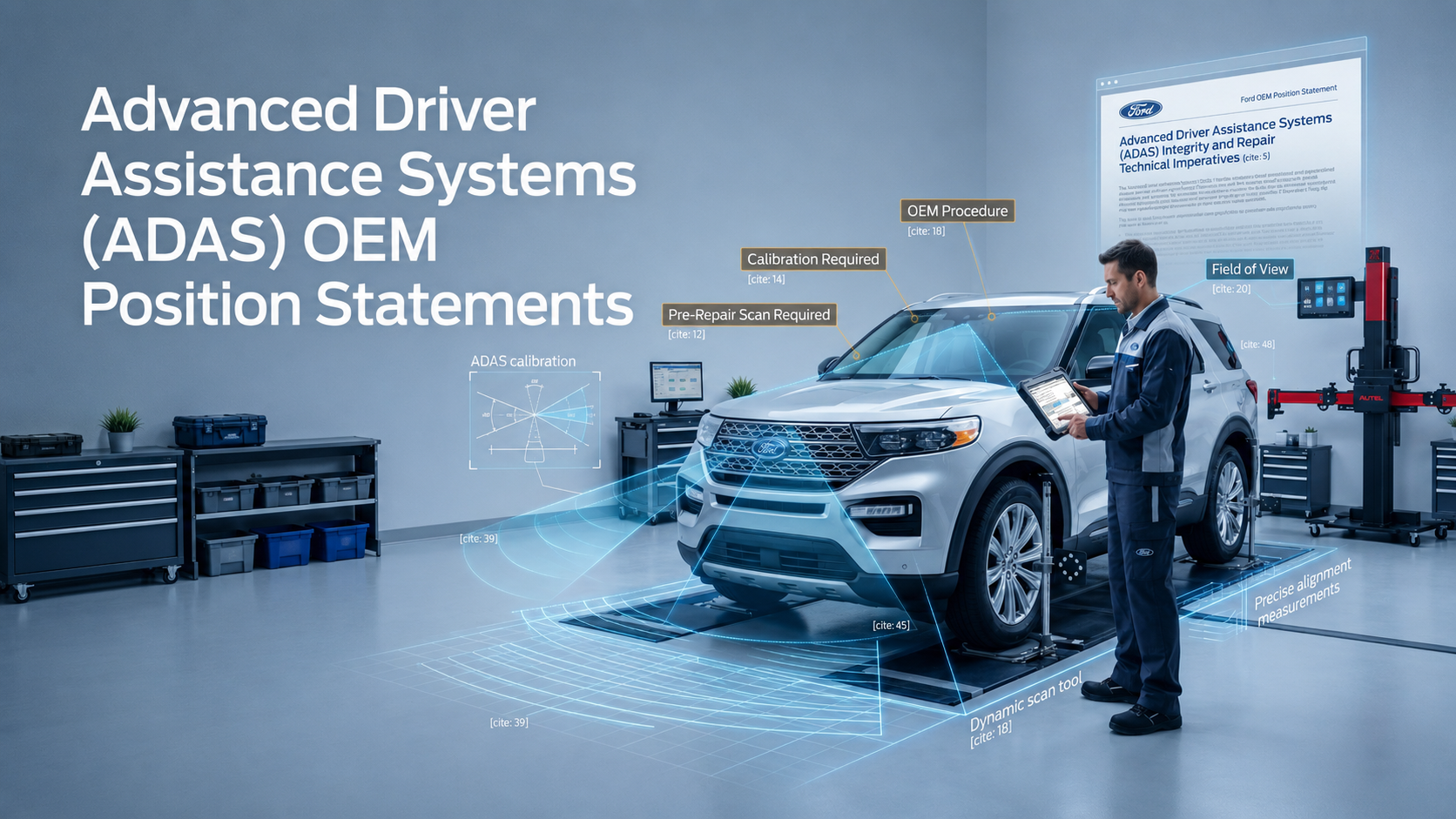
Modern vehicles are no longer just mechanical machines. They are rolling networks of cameras, radar sensors, control modules, and software-driven safety systems. Features like lane keep assist, adaptive cruise control, blind spot monitoring, and automatic emergency braking all depend on one thing: precision.
That precision is exactly why OEM position statements have become so important in collision repair and ADAS calibration.
For many shops, ADAS can feel overwhelming. Requirements change constantly. Procedures vary by manufacturer. Insurance pressure remains high. And technicians are often left trying to determine what is “recommended” versus what is truly required.
The reality is simple: OEMs are becoming far more direct about how repairs and calibrations must be performed. The guesswork is disappearing.
Need help finding the right ADAS frame? Use our free ADAS Equipment Advisor.
What Is an OEM Position Statement?
An OEM position statement is the vehicle manufacturer’s official guidance on how certain repairs, replacements, scans, or calibrations should be performed. These documents are built around engineering data, crash testing, and validation procedures developed specifically for that vehicle platform.
In practical terms, they tell repair facilities:
- What procedures must be followed
- What parts can or cannot be used
- When scans and calibrations are required
- What environmental or tooling requirements exist
- How repairs can impact safety systems
These statements are not simply suggestions created by a legal department. They are built from testing performed by the manufacturer itself.
In this short video, we look at why following OEM procedures and position statements has become such an important part of modern ADAS repair and calibration.
Why OEM Procedures Matter More in the ADAS Era
Traditional collision repair already required precision. ADAS systems raise the stakes significantly.
A radar sensor mounted a few millimeters out of specification can affect adaptive cruise control performance. A forward-facing camera mounted behind improperly refinished glass can alter lane detection. Excessive paint thickness on a bumper cover can interfere with radar transmission.
ADAS systems do not “guess.” They rely on exact data.
That means modern repairs must also become more exact.
A vehicle may appear repaired visually while still having hidden calibration issues underneath. In many cases, there may not even be a warning light present.
Honda specifically states that the absence of dashboard warning lights is not a reliable method for determining whether diagnostic scans are needed because many Diagnostic Trouble Codes do not trigger visible warnings.
That changes the entire repair process.
Calibration is no longer just a final step after repairs. It is part of a documented workflow that begins before the repair even starts.
OEMs Are Tightening Repair Standards
Recent OEM updates show just how serious manufacturers have become about ADAS repair accuracy.
According to a 2026 industry report published by Autobody News, Ford, Lincoln, and GM recently tightened requirements surrounding diagnostic scans, calibration procedures, refinishing limitations, and approved repair methods tied to ADAS-equipped vehicles.
Some of the biggest changes include:
Mandatory Pre- and Post-Repair Scans
Ford and Lincoln now explicitly require diagnostic scans before and after repairs to identify hidden issues and confirm that no additional faults were introduced during the repair process. GM similarly states that any repair disrupting battery voltage or electrical systems may require follow-up scanning.
This matters because many ADAS-related faults are invisible without a proper scan tool.
Calibration Regardless of Fault Codes
Ford and Lincoln also clarified that ADAS components affected during repairs should be calibrated even when no fault code is present.
That is a major shift in mindset for many repair facilities.
The absence of a warning light does not mean the system is functioning correctly.
Paint Thickness Restrictions
Some radar systems are mounted behind bumper fascias and depend on proper radar transmission through the material. Excessive paint thickness can interfere with signal strength and sensor performance.
GM established highly specific paint thickness limits for ADAS-equipped bumper repairs, while Ford warned that excessive paint layering may weaken or redirect radar signals.
Toyota also issued refinishing guidance related to clear coat blending and paint application standards.
For shops, this means refinishing procedures are now directly tied to calibration performance.
OEM Parts Requirements
Position statements increasingly warn against using aftermarket, recycled, or salvaged ADAS-related components.
Ford stated that recycled or aftermarket ADAS sensors may not perform correctly during calibration. Stellantis similarly warned that salvage components may carry previous impact damage or dimensional inconsistencies that compromise vehicle safety.
The message from OEMs is becoming very clear: calibration accuracy depends on the entire repair ecosystem working correctly together.

The “Recommended” vs. “Required” Debate
One of the biggest areas of confusion in the industry is the language used in OEM procedures.
Some documents use the word “recommended.” Others use “required.” In practice, many industry experts argue those terms should be treated very similarly when vehicle safety systems are involved. An industry discussion published through I-CAR RTS highlights how OEM repair procedures are increasingly viewed as essential guidelines for restoring vehicles safely and properly after collision damage.
If a manufacturer publishes a documented procedure tied to vehicle safety systems, ignoring it creates unnecessary risk for the repair facility.
This is especially important as insurers, OEM certification programs, attorneys, and consumers become more aware of calibration documentation.
Repair facilities are increasingly expected to demonstrate not only that calibrations were performed, but that they were performed according to OEM procedures.
Technology Is Helping Shops Navigate OEM Requirements
One of the biggest challenges for collision repair facilities is simply keeping up with constantly changing OEM procedures and calibration requirements.
That is where modern workflow and repair order “scrubber” tools are becoming increasingly valuable.
Platforms such as REVV, ViceADAS, ADASThink, and similar workflow systems help shops analyze estimates, identify likely calibration requirements, flag OEM procedure considerations, and surface documentation tied to specific repairs. These tools can help reduce missed operations and improve consistency throughout the repair planning process.
Many shops are also leveraging online OEM information systems and repair databases to access position statements and procedural guidance more efficiently. Resources such as ALLDATA’s OEM Position Statement Access Guide help technicians and estimators locate manufacturer repair documentation that may impact scanning, calibration, parts usage, and refinishing procedures.
These systems do not replace technician judgment or OEM repair procedures themselves. But they can help shops organize information, improve documentation, and create more repeatable workflows as ADAS requirements continue evolving.
As one experienced calibrator explained during a recent discussion, the volume of evolving OEM guidance has become difficult for any single technician to manually track every day.
That is one reason workflow software and repair procedure integration tools are becoming more common across the collision industry.
Why This Matters for Your Shop
ADAS requirements are only becoming more complex. Vehicle manufacturers continue adding new sensors, tighter tolerances, and more detailed repair standards every year.
For many shops, the challenge is not willingness. It is clarity.
Technicians want to do the job correctly. Shop owners want confidence that repairs are safe, documented, and profitable. But without structured workflows and ongoing support, ADAS can quickly feel difficult to manage.
Hands-on training, repeatable calibration workflows, and long-term technical support help reduce uncertainty and build confidence over time. Because at the end of the day, calibration is not just about equipment. It is about returning vehicles to full safety with confidence.
Final Thoughts
OEM position statements are becoming the rulebook for modern collision repair and ADAS calibration.
They define the repair process. They reduce guesswork. And they help ensure that repaired vehicles perform the way manufacturers intended.
As OEM requirements continue evolving, shops that build disciplined calibration workflows now will be in a much stronger position moving forward.
Want Help Building a More Confident ADAS Calibration Workflow?
If your shop is evaluating in-house ADAS calibration, we can help you better understand equipment options, workflow requirements, training needs, and long-term support considerations.
Topics:
