
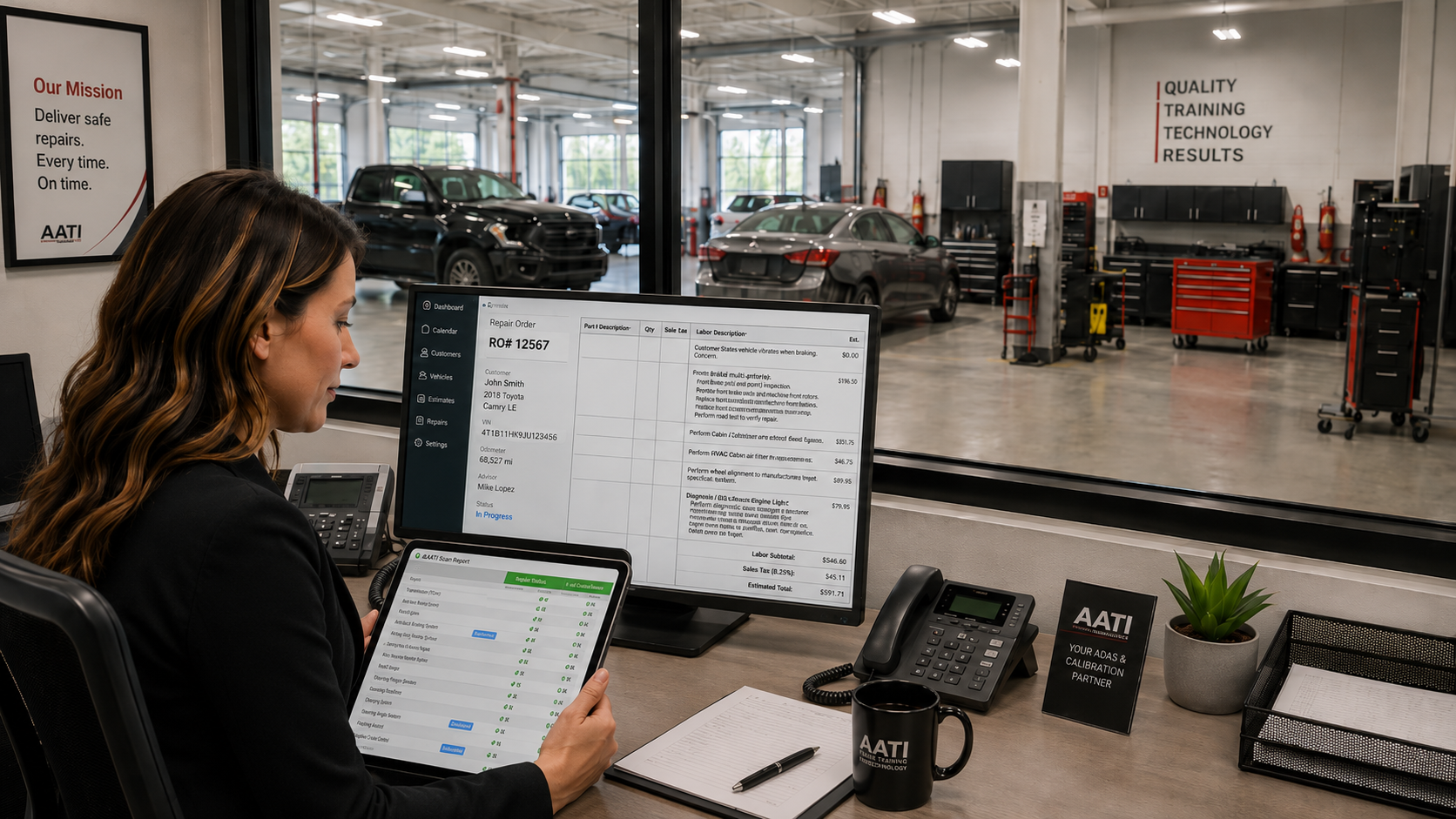
ADAS calibration pricing can feel unclear at first.
Shops need pricing that is competitive, fair to the customer, clear enough for insurance review, and profitable for the business. That balance matters because ADAS calibration is more than a simple tool function. It involves trained technicians, accurate setup, OEM procedures, scan reports, documentation, and quality control.
A calibration price should reflect the actual work required to return the vehicle to proper operating condition.
When pricing is based on the procedure, the vehicle, the documentation, and the local market, it becomes easier to explain. It also becomes easier to support when an insurer, estimator, or customer asks why the charge is necessary.
Need help finding the right ADAS frame? Use our free ADAS Equipment Advisor.
ADAS Calibration Pricing Should Be Based on the Required Procedure
Every calibration should begin with the vehicle’s actual repair requirement.
ADAS calibrations vary by manufacturer, model, system, repair operation, and OEM procedure. A forward-facing camera calibration may be static on one vehicle, dynamic on another, and static plus dynamic on another. Some vehicles may require multiple setup steps, more than one target, an alignment check, or a road test under specific conditions.
Procedure-based pricing gives the shop a clearer way to price the operation and support the repair order. I-CAR’s OEM Calibration Requirements Search reinforces this point. I-CAR says repairers can use the tool to identify which systems a vehicle may be equipped with and determine whether calibration is required.
Procedure-Based Pricing Creates a Cleaner Repair Order
A strong ADAS pricing model is usually built around the calibration procedure being performed.
Technician time still matters. Equipment cost matters. Software, targets, bay space, training, setup, photos, reports, and administrative time all matter. Those costs should influence the shop’s pricing model. But the repair order is easier to explain when the charge is tied to the actual procedure.
For example, a shop may price a forward-facing camera calibration differently than a front radar calibration, blind spot calibration, surround-view calibration, dynamic calibration, or static-plus-dynamic calibration. That structure gives estimators and technicians a more consistent way to write the repair order. It also helps prevent the shop from undercharging when the procedure is more involved.
Revv’s Price your ADAS calibrations, Feb. 3, 2026, article gives useful market context, noting an average calibration cost of $350 to $500 and listing baseline examples such as radar calibration at $300–$400, blind spot monitor calibration at $300–$400, backup camera or sensor calibration at $250–$300, lane keep assist/lane departure warning at $300–$400, and 360-degree camera calibration at $350–$450. Revv also notes that pricing should reflect market conditions and operating costs.
These ranges are useful benchmarks. They should help frame the conversation, while still allowing each shop to price according to its market, equipment, training, workflow, and procedure requirements.
Local Market Data Helps Shops Stay Competitive
Most collision centers already have useful pricing information in their own records.
Past sublet invoices, dealer calibration invoices, mobile calibration charges, and vendor pricing can all help establish a local market baseline. These records show what the shop has already been paying and what insurers may have already approved in similar situations.
That market history is valuable. It helps the shop avoid guessing. It also helps the shop understand where its own in-house pricing should fall. A shop that brings calibration in-house may reduce delays, improve documentation, control scheduling, and keep the repair moving. Those benefits have business value, especially when calibrations are delaying cycle time or creating supplement friction.
The Price Should Reflect the Full Calibration Workflow
ADAS calibration involves more than the moment the tool confirms a successful result.
A complete workflow may include repair procedure research, pre-scan, vehicle preparation, alignment verification, target setup, measurement, calibration, road testing, screenshots, photos, post-scan, report creation, and repair order support. Some procedures are straightforward. Others require more time, more documentation, or additional diagnosis before the vehicle is ready.
A practical calibration pricing structure may account for:
- Pre-scan and post-scan
- OEM procedure research or ADAS requirement review
- Static calibration
- Dynamic calibration or calibration road test
- Static plus dynamic calibration
- Radar, camera, blind spot, parking sensor, or surround-view calibration
- Alignment check or alignment correction when required
- Calibration report, photos, screenshots, and documentation support
The goal is to make sure the repair order reflects the work required. A shop that only prices the tool function may miss the real cost of setup, documentation, technician skill, and administrative support.
Clear Line Items Make Calibration Easier to Explain
ADAS calibration should be visible on the repair order.
When calibration work is buried inside general labor or written as a vague miscellaneous charge, it becomes harder to explain. Clear line items help the estimator, insurer, and customer understand what was done.
Plain language works best. The repair order should identify the system calibrated, the type of procedure performed, and the documentation included. A forward-facing camera static calibration should be written differently than a dynamic road test calibration or a blind spot sensor calibration.
Consistency also matters. When the shop uses the same naming, documentation standards, and pricing structure across repair orders, the process becomes easier for the whole team. Estimators know how to write it. Technicians know what to document. Insurers see a more professional and repeatable process.

Documentation Makes the Price Easier to Support
A fair price is easier to approve when the documentation is complete.
Insurance review often comes down to three basic questions: Was the calibration required? Was it performed correctly? Is the charge reasonable for the work? Good documentation helps answer those questions without turning every repair order into a debate.
Autel’s collision repair workflow page describes a process that starts with a pre-scan to identify ADAS systems, includes an alignment check and digital inspection, and supports documenting the condition of steering, suspension, brakes, tire wear, and related systems. Autel also notes that the IA900 system guides documentation in real time, including pre-scan, inspection, alignment, calibration, and post-scan steps, with reports that can be stored and shared with customers or insurance companies.
A strong calibration file should include the vehicle information, pre-scan, post-scan, calibration report, relevant photos, screenshots, alignment documentation when applicable, technician notes, and quality-control review. The shop does not need to send every document with every repair order. But the file should be organized and ready when support is needed.
This is especially useful with dynamic calibrations. Static calibrations often have a visible setup that can be photographed. Dynamic calibrations happen on the road, so screenshots showing successful completion become important. The completed procedure should be documented clearly so the shop can show the calibration was performed and verified.
OEM Procedures Give the Price a Stronger Foundation
ADAS pricing is stronger when it is tied to OEM repair information.
OEM position statements and repair procedures help explain why calibration is required after certain repairs, replacements, scans, alignments, windshield work, bumper work, or sensor-related operations. They also help explain why calibration may be required even when there is no warning light on the dash.
In our blog article Navigating the Rulebook: The Critical Role of OEM Position Statements, May 21, 2026, we explain that these documents help shops understand what procedures must be followed, when scans and calibrations are required, what environmental or tooling requirements may exist, and how repairs can affect safety systems.
The OEM procedure helps remove opinion from the pricing conversation. It shows why the work belongs on the repair order.
Insurance Approval Improves With a Consistent Process
Insurance approval becomes easier when the shop follows the same process every time.
A consistent process helps connect the repair operation to the required calibration, the completed work, and the final documentation. It gives the estimator a clearer story to tell. It gives the insurer a cleaner file to review. It gives the shop a stronger position when a calibration line item is questioned.
In our blog post, Setting the Right Precedent for ADAS Calibration Insurance Approval we explain that weak documentation can cause valid procedures to be delayed or denied because the repair is not clearly connected to the OEM requirement. It also notes that strong documentation, including pre-repair scans, post-repair scans, baseline repair documentation, and OEM repair procedures or position statements, helps make approval more predictable.
The best insurance conversations are professional, factual, and calm. The repair order should show the work clearly enough that the documentation does most of the explaining.
Low Pricing Can Undervalue the Work
Every market has providers who charge less.
Lower pricing may be valid in some cases. Some procedures are simpler. Some shops have high volume. Some markets are more competitive. But low pricing becomes a problem when it makes every calibration look the same.
They are not the same.
A low price may leave out research time, setup time, documentation, road testing, training, software cost, failed calibration diagnosis, or administrative support. It may also create the impression that calibration is just a quick button press.
A shop that has invested in equipment, training, workflow, documentation, and quality control should price the work accordingly. The price should be fair, competitive, and tied to the value of performing the procedure correctly.
Pricing Should Be Reviewed Regularly
ADAS pricing should evolve as the shop gains experience.
Vehicle technology changes. OEM procedures change. Software costs change. Technician wages change. Insurer expectations change. The shop’s own process also changes as the team becomes more efficient and learns which procedures require more time or documentation.
Reviewing pricing a few times a year helps keep the model accurate. Shops should compare current pricing against local providers, dealer invoices, mobile calibration charges, actual technician time, documentation time, supplement behavior, and profitability.
CCC has reported that calibration is becoming a larger part of collision repair in its The Current State of Calibrations: A Turning Point for Collision Repair, Nov. 12, 2025. In its analysis, CCC said calibrations appeared on more than 23% of repairable appraisals, with average calibration fees reaching about $500 per repairable vehicle. CCC also noted that calibrations often appear later as supplements, which can add cost and complexity to the repair process.
That trend makes pricing discipline more important. ADAS calibration is becoming part of the core repair workflow for many collision centers. It deserves the same pricing discipline as any other skilled repair operation.
Final Takeaway: Price the Procedure and Prove the Work
ADAS calibration pricing should be competitive, accurate, and profitable.
The strongest pricing model is built around OEM requirements, procedure complexity, local market conditions, documentation quality, and shop profitability. That structure helps the shop explain the charge, support the repair order, and protect the value of the work.
When pricing is tied to the actual repair requirement and supported by good documentation, the conversation becomes easier. The shop is showing the work required to complete the repair properly.
Need Help Building a Competitive ADAS Calibration Pricing Strategy?
Applied Automotive Technology helps collision centers understand ADAS equipment, calibration workflow, training, documentation, and pricing considerations.
We perform calibrations in our own shop and support many other shops in our area, so we see real-world ADAS pricing every day, what works, what gets challenged, and where shops can run into trouble.
Whether you are bringing calibration in-house for the first time or improving an existing process, we can help you build a more confident, competitive approach.
If you need help building a pricing strategy, reach out to us. We’re here to help you make ADAS calibration a successful part of your business.
Topics:
