Many body shops already know they need to take ADAS calibration more seriously.
The harder question is usually this:
Where are we supposed to do it?
For a lot of growing collision shops, space feels like the barrier. The shop may not have a dedicated ADAS room. It may not have 40 feet of open floor space sitting unused. It may already be tight on repair bays, alignment work, parts carts, and vehicle movement.
That is why the Autel ADAS Bay Max Lift is worth a closer look.
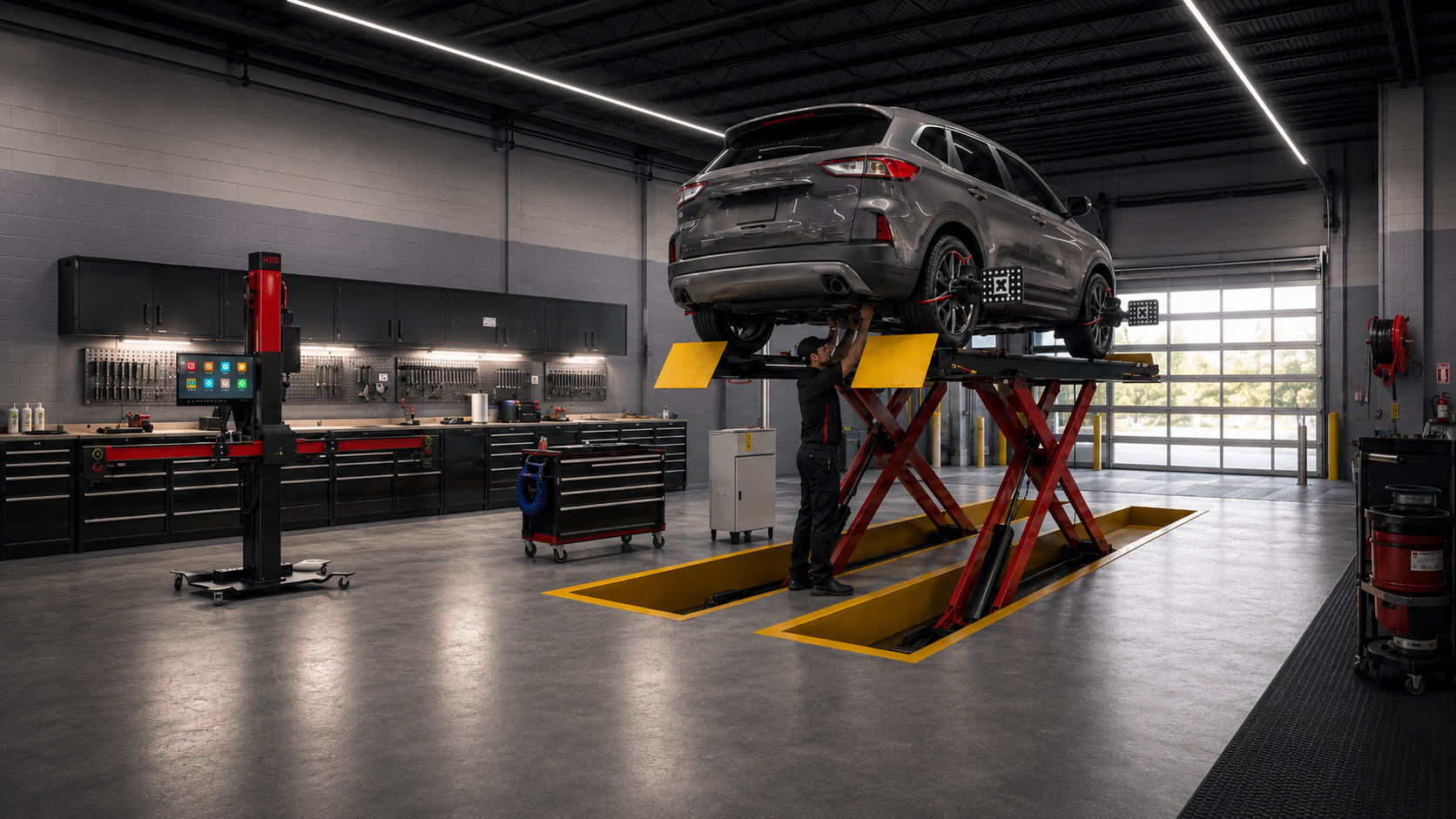
The Bay Max is not just a lift. It is designed to help a shop make one bay more productive by combining mechanical repair, wheel alignment, and ADAS calibration in a single alignment or repair bay. Autel describes the Bay Max as a flush-mount scissor lift engineered for mechanical repair, wheel alignment, and 360 ADAS calibration in one standard alignment bay space.
For the right shop, that can mean fewer sublets, fewer delays, and more control over the repair process.
Need help finding the right ADAS frame? Use our free ADAS Equipment Advisor.
The Space Problem Body Shops Think They Have
One of the biggest misconceptions about ADAS calibration is that every shop needs a huge dedicated calibration center to get started.
Space does matter. There is no way around that. Some calibrations require more room than others. Some OEM procedures have very specific setup requirements. The vehicle, the target, the floor, the lighting, the tire pressure, the alignment, and the calibration equipment all matter.
But that does not mean every calibration requires a massive open room.
We break down the practical setup side in our blog, Inside an ADAS Calibration Bay: Equipment, Space & Setup Requirements. That article walks through the space, floor levelness, lighting, Wi-Fi, tools, and organization factors that help a calibration bay function properly — the same issues a shop should understand before deciding whether a Bay Max-style setup can help one bay do more.
BodyShop Business addressed this directly in its article, ADAS Space in the Auto Body Shop: Think Inside the Box. The article explains that many shops overestimate the amount of space required, especially for forward-facing camera and radar work. It notes that much of the “bread and butter” ADAS work involves forward-facing cameras and radar, which often require usable space in front of the vehicle rather than a large dedicated calibration center.
That is an important shift in thinking.
Instead of asking, “Do we have a perfect ADAS room?” a growing body shop should ask:
Can we design one bay to handle more of the repair, alignment, and calibration process correctly?
Why Alignment and ADAS Calibration Belong in the Same Conversation
ADAS calibration and wheel alignment are closely connected.
Many systems depend on the vehicle being properly positioned and level. Some OEM procedures require alignment checks or adjustments before calibration. I-CAR RTS, OEM Pre-Repair Calibration Requirements gives examples of OEM pre-calibration requirements that include vehicle level, tire pressure, unloaded vehicle condition, fluid levels, fuel level, and even four-wheel alignment before certain radar alignment procedures.
For a deeper look at why alignment needs to come before calibration, we cover this in more detail in Why Wheel Alignment is the Unskippable First Step of ADAS Calibration. The key point is simple: ADAS calibration depends on the vehicle’s physical geometry being correct before targets are placed and procedures are performed.
If a shop repairs a vehicle, sends it out for alignment, brings it back, and then performs or sublets calibration, every handoff adds time. It also adds possible delays, incomplete documentation, and workflow challenges.
For accurate alignment work, the lift matters. An alignment lift with built-in turn plates allows the tires to move freely while readings are taken and adjustments are made. Without that freedom of movement, the tires can fight the friction of the floor, making the process harder and potentially less precise. Turn plates help the technician work more efficiently and get better alignment readings.
Yes, some shops try to do alignments on the floor. But that usually means lifting the vehicle, making an adjustment, setting it back down, checking it, lifting it again, and repeating the process.
That may be possible. It is not efficient.
A drive-on alignment lift is simply the better workflow. And a flush-mount alignment lift gives the shop even more flexibility because it can become part of the ADAS space when lowered into the floor.
What the Autel ADAS Bay Max Lift Is Designed to Do
The Autel ADAS Bay Max is available in 12,000-pound and 14,000-pound capacity versions. Autel lists features including recessed rolling jacking beams, a table riser, stainless steel front radius plates, rear slip plates, front and rear opening runways, flip-down wheel stops, built-in runway air inflation, and LED lighting.
In plain shop language, it is built to help a technician do more in one place.
A vehicle can enter the bay for inspection, mechanical work, alignment, and certain ADAS calibrations without being moved to another shop area.
BodyShop Business, Autel’s ADAS Bay Max Vehicle Lift, covered the Bay Max, describing it as a lift that combines mechanical repair, four-wheel alignment, and ADAS calibration in a single bay to improve efficiency and shop space.

The Real Workflow Benefit: Stop Losing Half a Day
Many collision shops still outsource alignments.
That may work when volume is low. But as calibration volume grows, subletting alignment can become a bottleneck. The vehicle goes to a tire shop, dealer, or alignment provider. It gets put into someone else’s queue. The shop may lose the vehicle for half a day or more.
That delay affects cycle time.
This can also affect the calibration workflow. If the vehicle still needs ADAS work after alignment, the shop has to bring it back, verify setup conditions, perform the calibration, document the work, and move the job forward.
That is the Bay Max advantage: instead of sending the vehicle out and waiting for another provider’s schedule, the shop can keep the process in-house — align it, calibrate it, document it, and continue the repair without losing unnecessary time.
That is the real business case.
The Bay Max helps a shop reduce unnecessary movement. It supports a more controlled process:
- Pre-scan and inspect the vehicle
- Complete mechanical or collision-related repair steps
- Perform alignment work
- Verify OEM setup requirements
- Perform applicable ADAS calibrations
- Document the repair and calibration results
One Important Technical Detail: Height and Plane Matter
The Bay Max can make a bay more useful, but it does not remove the need to follow calibration rules.
First, for certain radar calibrations, the target is positioned at the height of the radar. If the vehicle is raised, the target height may need to be adjusted accordingly.
Second, for camera calibrations, lift height may need to be added into the calibration setup because the tool is expecting the vehicle and camera height to match the procedure’s required values. In other words, the technician has to account for the height of the lift when setting parameters.
The third point is even more important: surround-view calibrations can be different.
For surround-view calibrations, the floor target often needs to be on the same plane as the vehicle. If the vehicle is raised on a lift while the target remains on the floor below, the setup may not meet the calibration requirements. This is why shops need to understand which procedures can be performed with the vehicle raised, and which require the vehicle and targets to be level with one another.
Flush-mount design matters. When recessed into the floor and lowered, the Bay Max can help create a flatter, more open working area.
What Makes a Flush-Mount Lift Different?
A traditional above-ground alignment rack can be very useful. But it still takes up physical space and creates approach issues for some vehicles.
A flush-mount lift changes that.
A flush-mount design can be especially useful for lower vehicles because the technician does not have to drive the car up onto a raised ramp. The vehicle can be driven straight into the bay, positioned properly, and then raised as needed for inspection, alignment, or repair work.
For ADAS work, the bigger benefit is what happens when the lift is lowered.
When recessed into the floor, the lift area can become a flatter, less obstructed workspace. That gives the shop more flexibility for target placement, vehicle repositioning, and movement around the vehicle.
Autel states that front-facing radar and camera calibrations can be performed in an alignment bay with as little as 10 feet available in front of the lift, and that forward-facing plus blind spot calibrations can often be performed within repair bays by repositioning the vehicle. Autel also notes that vehicle placement varies by make and model.
Is the Bay Max Right for Every Shop?
No.
And that is an important point to say clearly.
The Bay Max makes the most sense for shops that are serious about controlling more of the repair process in-house. It is especially relevant for shops that:
- Already sublet a meaningful amount of alignment work
- Are growing their ADAS calibration volume
- Want to reduce cycle-time delays from outside vendors
- Have or are planning around Autel IA900 or IA1000 equipment
- Want one bay to support repair, alignment, and calibration workflow
- Are willing to train technicians and follow OEM procedures carefully
It may not be the right first step for a shop that has very low ADAS volume, no alignment strategy, no trained technician, or no clear plan for pricing and documentation.
A shop should look at its repair mix, current sublet spend, available bay space, technician skill level, calibration opportunity, and expected return. The question is not simply, “Can we fit this lift?”
The better question is: Will this lift help us build a more efficient, profitable, and controlled repair process?
How We Helps Shops Decide
ADAS is complex. Buying equipment without a plan can make it even more confusing.
AATI helps shops evaluate the whole picture: Autel equipment, bay layout, alignment needs, calibration goals, technician training, workflow, ROI, and long-term support.
That matters because the Bay Max is not just a product decision. It is a business decision.
Used correctly, it can help a shop reduce sublets, keep more work in-house, improve cycle time, and build a more profitable calibration process.
If you are considering ADAS calibration, alignment, or a Bay Max-style setup, start with a simple conversation. Get in touch with us, we're here to help.
Because for many growing body shops, the opportunity is not across town at the sublet vendor.
It may already be sitting inside your own bay.
Topics:
