ADAS calibration is no longer a niche service. It is becoming a routine part of collision repair as more vehicles arrive equipped with cameras, radar sensors, and driver-assist systems that require precise recalibration after even minor repairs. For many shops, bringing calibration in-house is a logical next step. It offers more control over the repair process, reduces sublet delays, and opens up a meaningful revenue stream.
At the same time, not every shop is ready to make that move today. The decision is not just about purchasing equipment. It touches space, staffing, workflow, and overall business readiness. Shops that rush into it without thinking through those factors can find themselves struggling to integrate calibration effectively into their operation.
For shops evaluating the move, there are a handful of practical indicators that suggest it may be worth pausing, planning, and preparing before making the investment.
Need help finding the right ADAS frame? Use our free ADAS Equipment Advisor.
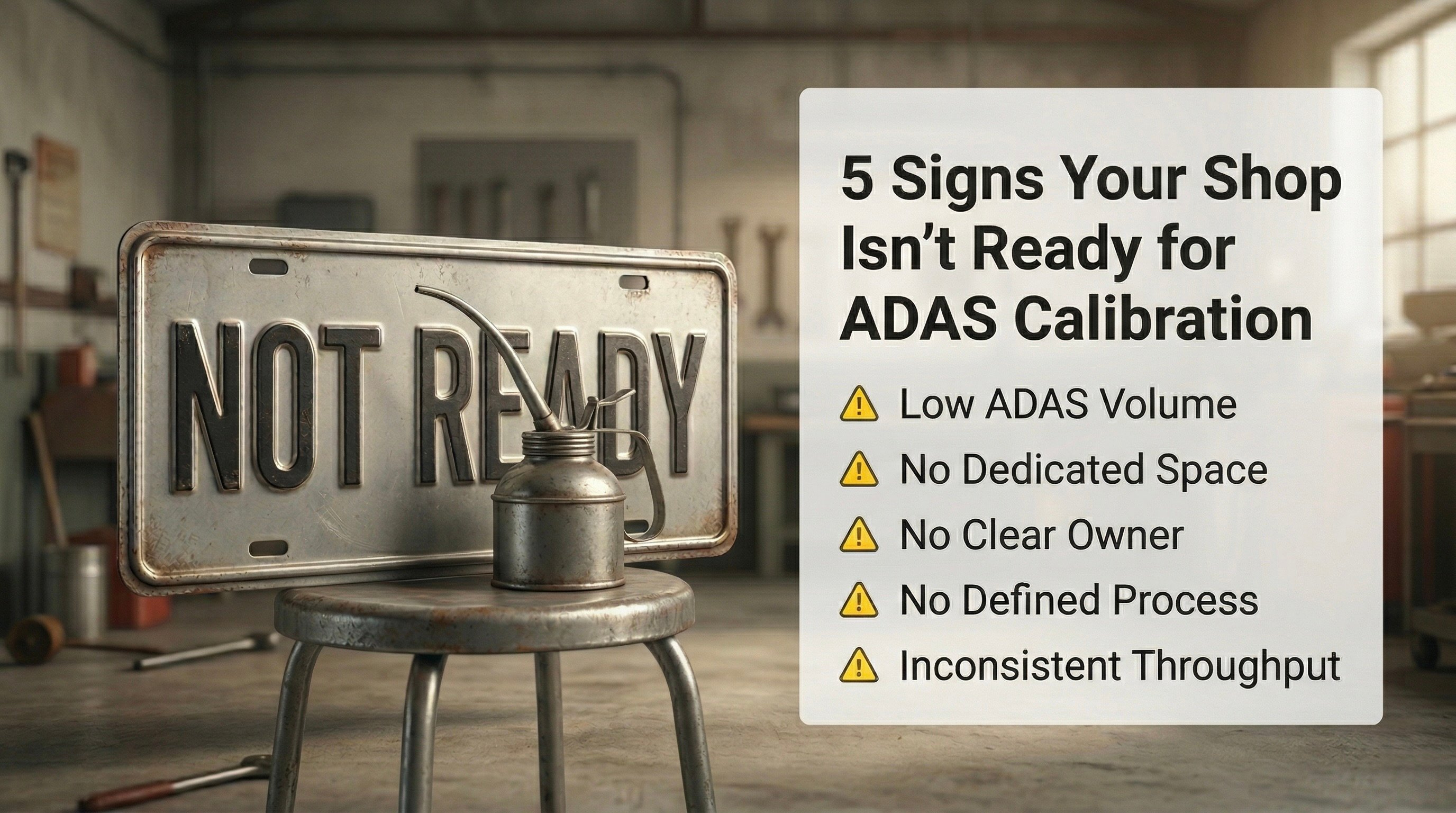
#1 Low ADAS Volume: Your Current Work Mix Doesn’t Support Consistent ADAS Demand
Not every shop sees the same volume of ADAS-related work. While newer vehicles are increasingly equipped with advanced driver-assist systems, the actual demand for calibration varies depending on the type of work a shop performs and the customer base it serves.
Shops focused heavily on restoration work, older vehicles, or primarily self-pay repairs may not encounter calibration needs as frequently. In those environments, customers are often more focused on getting the vehicle back on the road than restoring every safety system to pre-accident condition. That can limit both the frequency of calibrations and the willingness to pay for them.
At the same time, the broader trend is clear. According to U.S. ADAS Market Growth and Adoption – (NHTSA), advanced safety systems are becoming more common across the vehicle fleet, and that trend will continue.
The key question for any individual shop is whether that trend is showing up in their day-to-day operations today. Looking at weekly car count, the percentage of vehicles requiring calibration, and the number of calibrations per repair can provide a more grounded view. If the volume is still low or inconsistent, it may make sense to monitor growth before committing to in-house capability.
#2 No Dedicated Space: Space Is Already Tight in Your Shop
One of the most immediate challenges is physical space. ADAS calibration requires more than simply fitting another piece of equipment into an open corner. The process depends on controlled conditions, including proper lighting, level flooring, and enough clearance around the vehicle to position targets and equipment accurately. In a busy collision environment, where vehicles, technicians, and equipment are constantly moving, that kind of controlled space is not always readily available.
Industry guidance consistently reinforces how sensitive calibration procedures can be to environmental factors. For example, Preparing The Vehicle For Calibration, (I-CAR RTS) highlights the importance of proper setup conditions to ensure accurate results.
In practice, shops that are already operating at full capacity often find it difficult to carve out a dedicated calibration area without disrupting production flow. That does not mean it cannot be done. Many shops reconfigure layouts, repurpose underutilized areas, or phase in calibration space over time. But if there is no clear path to creating a controlled environment today, it is a strong signal that more planning is needed before moving forward.
#3 No Clear Owner: You Don’t Have the Right Person to Own ADAS Calibration
ADAS calibration is often described as procedural, and that is true to a point. The tools and software guide technicians step by step through the process. However, successful calibration still depends heavily on the person performing the work. Attention to detail, patience, and the ability to follow processes without cutting corners are critical traits.
Equally important is the ability to recognize when something is not working as expected and to work through the issue methodically. That is where experience and problem-solving ability come into play. Shops sometimes assume their most advanced technician should take on calibration work, but that can create a different problem. Pulling a top technician away from complex mechanical or diagnostic work can create bottlenecks elsewhere in the shop.
Many successful shops instead assign calibration to a technician who is comfortable with technology, disciplined in following procedures, and able to stay focused without rushing. As noted in Why ADAS Calibration After Collision Repairs is Essential (FenderBender Magazine), improper calibration can have serious safety and liability implications, making consistency and accuracy essential.
If your team is already stretched thin, or if there is no clear candidate to take ownership of calibration without disrupting other areas of production, it may be worth addressing that gap first.
#4 No Defined Process: The Business Model Isn’t Fully Defined Yet
Bringing ADAS calibration in-house is not just a technical upgrade. It introduces new considerations on the business side that need to be addressed upfront. Workflow changes, scheduling adjustments, documentation requirements, and insurance interactions all become part of the equation.
Calibration work must be properly identified, documented, and billed. Shops also need to be prepared to communicate with insurers about why those procedures are required and ensure they are being reimbursed appropriately. As discussed in ADAS Calibrations: Follow the Instructions – (BodyShop Business), the landscape around reimbursement continues to evolve, and shops that approach calibration with clear processes and operational discipline are far better positioned to capture revenue and avoid costly friction.
Without a defined approach, shops can find themselves performing calibrations inconsistently, struggling with billing, or underutilizing their equipment. On the other hand, shops that take the time to think through how calibration fits into their overall operation tend to integrate it much more smoothly and profitably.
#5 Inconsistent Throughput: Throughput Hasn’t Yet Reached the Level Needed to Support the Investment
Ultimately, the decision to bring calibration in-house comes down to volume and consistency. Shops that are turning a steady number of vehicles each week often discover that a significant portion of those vehicles require one or more calibrations. Over time, that creates a meaningful revenue opportunity.
However, if throughput is low or inconsistent, it can take much longer to realize a return on investment. Tracking basic metrics such as vehicles per week, calibrations per vehicle, and average revenue per calibration can provide a clearer picture of potential.
Even modest increases in calibration volume can add up quickly, but those gains depend on having enough consistent work flowing through the shop. Without that foundation, it may be better to build volume first and revisit the decision later.
The Bottom Line
Many shops are closer to being ready for ADAS calibration than they think. Often, it comes down to a few key areas—space, training, process, and volume—that can be improved over time.
What separates successful implementations from frustrating ones is timing. Shops that take the time to evaluate their current operation and address these factors upfront are far more likely to see calibration become a productive and profitable part of their business.
For those considering the move, the question is not just whether ADAS calibration makes sense. It is whether the shop is positioned to support it today, or what needs to change to get there. If you want a clearer picture of what that looks like for your shop, our ROI Calculator can help you estimate the volume and return based on your operation.
If you’d prefer to talk it through, we’re happy to walk through it with you and share what’s working in real-world calibration environments.